


Quick Answer:
An intermediate MTB rider in Cusco is someone capable of riding narrow singletrack trails, controlling speed on steep descents, and navigating obstacles such as rocks, roots and switchbacks. However, because Cusco sits at 11,152 ft (3,399 m), altitude significantly increases difficulty. Riders should also be physically prepared and properly acclimatized before attempting intermediate routes in the Sacred Valley.
If you’re planning to travel to Cusco and try mountain biking, you’ll surely find tours classified as “beginner,” “intermediate,” or “advanced.” But what does intermediate MTB level Cusco really mean?
Riding at an intermediate level in Cusco? Our day tours are designed for riders who want authentic MTB adventures in Cusco, always safer and more rewarding when you understand the skills required, the trail difficulty, and the altitude reality.
Here conventional trail rating systems (like the IMBA system or color scales) often fall short. Reality introduces its own difficulty ecosystem where rules change drastically.
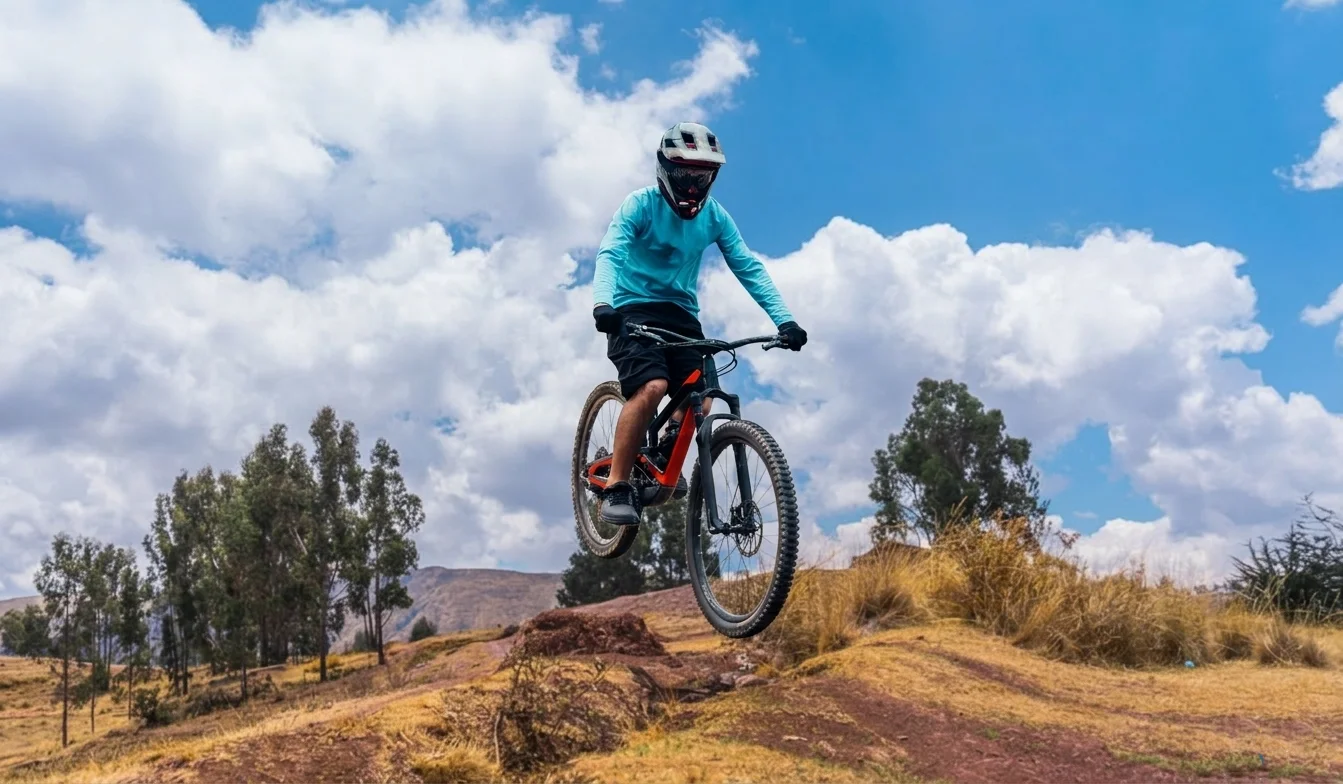
Intermediate MTB level Cusco: practical definition
Simply put, a rider with intermediate level must have the confidence and technique to descend steep slopes, dodge obstacles (rocks/roots) and control speed without abusing brakes, all this standing on the bike and on narrow dirt trails (singletracks), not on wide roads.
📊
According to local operators and MTB guides in Peru: an intermediate rider can
📏 Cover typical distance:
9.3-15.5 miles (15-25 km)
⏱️Routes with duration:
3-5 hours
📉 Elevation drop:
Between -2,625 to -4,921 feet (-800 to -1,500 m)
🛤️ Terrain:
Dirt roads, Inca trails, curves and flow sections.
💪 Physical demand:
Moderate endurance, prior altitude acclimatization.
Important note:
In Cusco, intermediate level means you don’t need to be expert, but you do need basic MTB experience and good physical condition.

Cyclist Doing a Drop on Technical Trail
Why MTB difficulty feels harder in Cusco?
The difficulty of mountain biking in Cusco is influenced by three major factors: altitude, natural terrain, and sustained descents. Many trails start above 13,000 ft (4,000 m) and include ancient Inca paths, rock gardens and tight switchbacks. Even riders with intermediate experience at sea level may find these routes more demanding in the Andes.
Basic Mountain Biking Skills: “Intermediate” Checklist
For a local guide to consider you fit for intermediate MTB level Cusco, you should master the following basic mountain biking skills:
Fundamental skills
| Basic Skills | What it means in practice |
| Dynamic body positioning | You know how to shift your weight forward or back according to terrain. On descents you carry weight back, heels down and elbows flexed; on technical climbs you load more forward to maintain front wheel traction. You don’t stay rigid on saddle and stand on pedals when terrain demands. |
| Modulated braking | You use both brakes coordinately, normally with greater front brake role. You don’t brake abruptly like a switch; you regulate pressure according to situation. You can brake hard without locking wheels and understand that in curves you brake before entering, not mid-turn. |
| Active line choice | You look 10 to 16 feet (3 to 5 m) ahead, not right in front of wheel. You identify a clean line between rocks, roots or other irregularities, and can correct it in real time if terrain changes. When trail gives you options, you decide and execute without freezing. |
| Corner handling | You can take wide curves at moderate speed maintaining traction. You know to drop outside pedal and raise inside on tight turns, and use your gaze toward curve exit to guide bike. You also handle open switchbacks with control, braking before entering. |
| Basic obstacles | You safely pass over small roots and fist-sized rocks at moderate speed. You can ride down steps or drops of 8 to 12 inches (20 to 30 cm) using good weight-back technique. You maintain momentum on climbs with embedded rock and resolve small water or ditch crossings without excessive fear. |
Intermediate skills
| Technical skill | What it means in practice |
| Tight switchbacks | You can take short radius curves slowly and controlled using technique. You understand basic counter-steering notions to better initiate bike lean and, if you lose balance, no problem putting a foot down to resolve curve. |
| Moderate rock gardens | In medium rock fields, you choose a line between them or around larger ones instead of hitting everything head-on. You maintain enough speed so suspension works well and absorbs impacts without bike feeling stuck. |
| Small to medium drops | You can drop 12 to 20 inches (30 to 50 cm) with control, compressing suspension before edge and releasing bike on exit. You don’t need to do it with aggressive style; just resolving it safely suffices. If drop is larger, getting off and walking is still a totally valid decision. |
| Berms and flow features | You take advantage of banked turns to conserve speed, understand basic timing on rollers and undulations to compress and extend body, and can generate momentum on pump tracks without relying on pedaling, using better your position and movement on bike. |
Important note:
Having basic skills (1-5) and some intermediate skills (6-9) defines you as a competent cyclist. But upon arriving in Cusco, the scale changes. Here, you’d be considered ‘intermediate-low’ because routes classified as ‘intermediate’ in Sacred Valley won’t be in the center of your comfort zone, but at the upper edge of your technical ability. It’s an incredible experience, but requires respect and total concentration.”
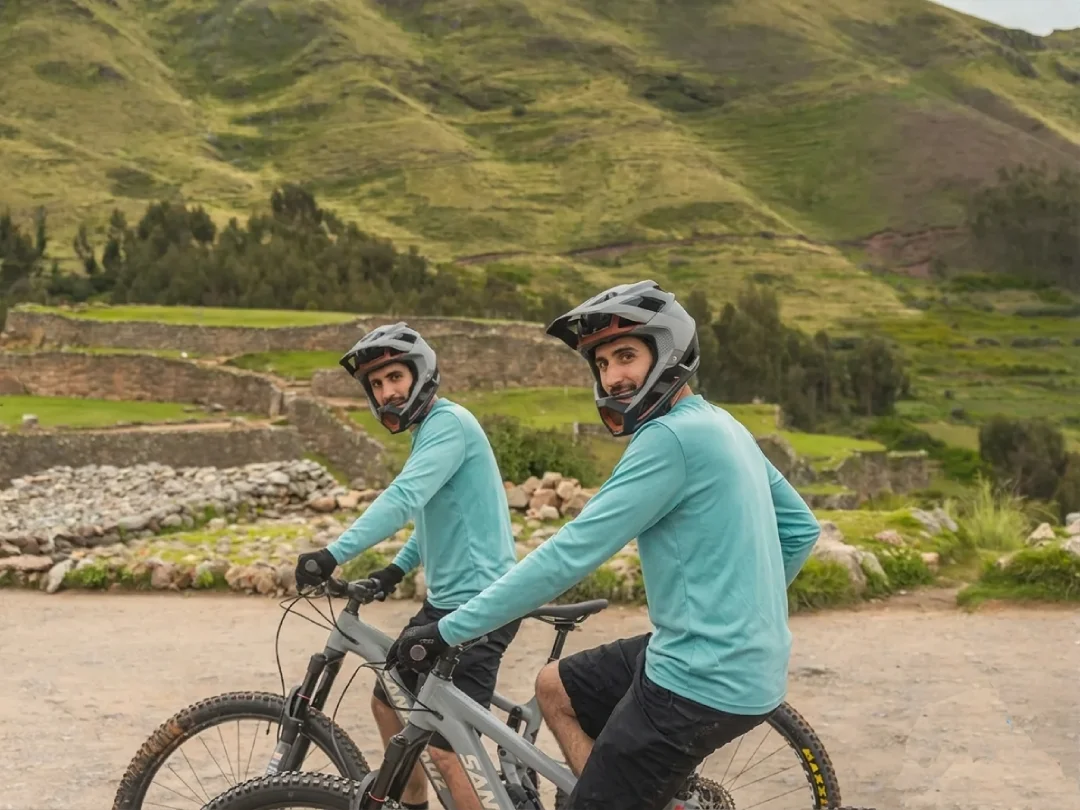
Two MTB Cyclists on Sacred Valley Route
Acclimatization: Not optional
Being an intermediate level cyclist in Cusco is impossible without prior physiological adaptation. Altitude acclimatization isn’t just advice, it’s the determining factor redefining any route’s difficulty. Without it, even the simplest path becomes a wall.
The Science Behind the Gasping:
At 11,155 feet (3,400 meters) altitude, air becomes scarcer and every breath counts. Available oxygen decreases significantly, directly affecting your performance. What in your city would be simple warmup, here can take your heart rate to intense effort zones in minutes. Your heart beats faster trying to maintain the same oxygen flow you’d have at sea level. In practical terms, your aerobic capacity is noticeably reduced some studies mention a drop between 15% and 20%, but beyond numbers, experience will make you feel it as soon as you pedal uphill.
Cyclist Resting with Bike at Sunset
Intermediate at sea level vs intermediate in Cusco table
| Aspect | Intermediate at sea level | Intermediate in Cusco |
| Altitude | Less physiological impact | Much more demanding |
| Braking | More margin for error | Less margin due to terrain and grade |
| Duration | More gradual fatigue | Faster fatigue |
| Technique | Important | Technique + acclimatization |
Adaptation Strategy:
- Humility is vital in the Andes: an elite cyclist fresh from lowlands will be easily outpaced by a local amateur if not respecting altitude.
- The 48-Hour Rule: Don’t attempt intermediate routes right after landing. Dedicate first two days to gentle walks and lots of hydration.
- Aggressive Hydration: At altitude, air is dry and you lose more water breathing. Drink more than your body asks for.
- Cadence over Force: When you start pedaling, use easy gears and maintain high cadence; don’t force muscles with heavy gears until your lungs have adapted.
MTB Difficulty Classification Peru
When talking about difficulty in Peruvian mountain biking, especially in Sacred Valley, forget conventional standards. Here, the mountain dictates rules through three brutal factors defining each route:
- Raw Technique: Forget machine-built “flow” trails. Here we face 100% natural and historic terrain with stone steps, technical rock gardens and tight switchbacks.
- Altitude Factor: Starting a route at 13,123 feet (4,000 m) above sea level changes the game. Oxygen scarcity affects your physical performance and, more importantly, your reflexes and decision-making.
- Sustained Endurance: These aren’t short descents. They’re massive descents with more than 4,921 feet (1,500 meters) of negative elevation. They require constant body and mental control for a long time, something much more fatiguing than a short technical trail.
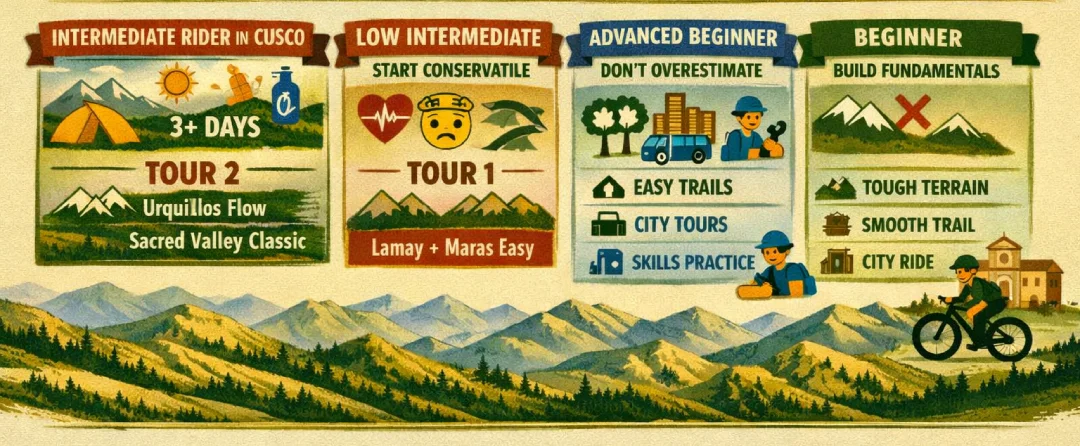
MTB Rider Levels in Cusco: Beginner to Intermediate Infographic
Color classification:
Cusco operators generally classify routes by a color code series indicating difficulty level:
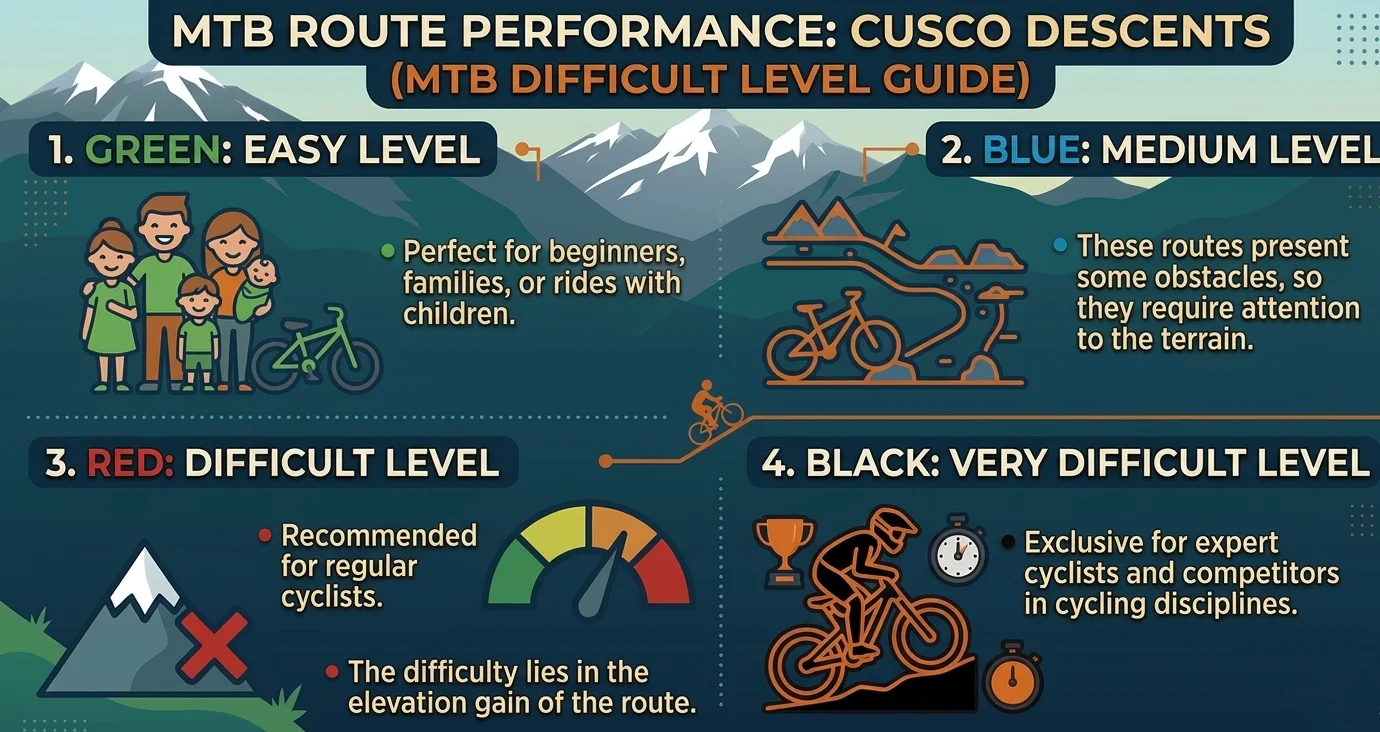
MTB Difficulty Levels in Cusco Infographic
Best Intermediate MTB Tours in the Region
If you confirm you have the right level, these are routes offering perfect balance between challenge and enjoyment:
- Maras and Moray (Sacred Valley): The quintessential intermediate tour. Dirt roads, incredible views and technical but manageable singletrack sections.
- Huaypo and Piuray Lagoons: Ideal for those seeking flow and landscapes without extreme descents.
- Urquillos Flow: As mentioned in previous guides, it’s the ideal route to gain speed without stress of large rocks.
Common mistakes believing you have intermediate level in Cusco
- Believing “intermediate” in Cusco equals intermediate at sea level
- Thinking knowing how to descend a wide track is already enough
- Ignoring acclimatization
- Overestimating braking technique and route
- Choosing route by operator marketing not by real elevation/terrain
How to know if you are ready for an intermediate MTB route?
| Signs you are ready | Signs you should start with beginner routes |
| Comfortable descending narrow singletracks | Always ride seated on descents |
| Can brake progressively without skidding | Panic on tight curves |
| Handle moderate rock gardens | Overuse brakes on steep sections |
| Ride standing on pedals during descents | — |
Thousands of travelers have trusted Peru Biking Tours to live unforgettable experiences in the Andes.
Your safety first
Routes adapted to your level, expert local guides and full support at all times.
Without worrying about anything
We take care of all the logistics so you can just focus on enjoying the scenery.
Authentic routes in Cusco
Experience the Sacred Valley in a real way, at your own pace, with access to the best trails.
Quality equipment
High-end enduro bikes, helmets and protective gear for all levels.
Plan your MTB experience in Cusco
MTB Day Tours in Cusco
If you want to explore MTB routes with the right logistics, local support, and suitable trail selection, check out our MTB Day Tours in Cusco.
E-bikes Tours
Curious how altitude impacts your e-bike in Cusco? Our E-Bike tours are designed for riders who want authentic enduro adventures in the Andes.


