


Quick Asnwer:
If you’re planning a ride in the Andes, the ideal MTB tires for Cusco are typically those that offer good volume, solid lateral grip, and a tread pattern capable of performing well on dust, gravel, rocks, and varied terrain. For most riders, a well-chosen trail tire setup usually provides the best balance between control, safety, and efficient pedaling.
If you are planning a route through the Andes, choosing the right MTB tires for Cusco can make a big difference in your overall experience. In this region, you are not riding on perfect trails or purpose built bike parks, but on natural mountain roads, rural routes, and terrain that shifts quickly between dust, gravel, and rock. That is why understanding which tires work best for MTB in Cusco will help you ride with more control and confidence.
Ready to ride in Cusco? Learn how to choose the right MTB tires to handle Andean terrain with safety and performance.
What the terrain is really like when you ride MTB in Cusco
When you ride mountain bike in Cusco, the terrain is usually very varied and often unpredictable. Unlike bike parks or trails designed only for cycling, many routes in this region follow natural mountain roads, old paths, and rural tracks.
One of the most distinctive elements of MTB in Cusco is the dry Andean dust, especially during the dry season, which runs roughly from April to October. This type of surface is usually fine and loose.
It is also common to find gravel roads or small loose stone, especially on routes that connect rural communities or agricultural areas. These roads may look easy at first, but loose rocks can make your bike drift or lose stability if you are not using the right tires.
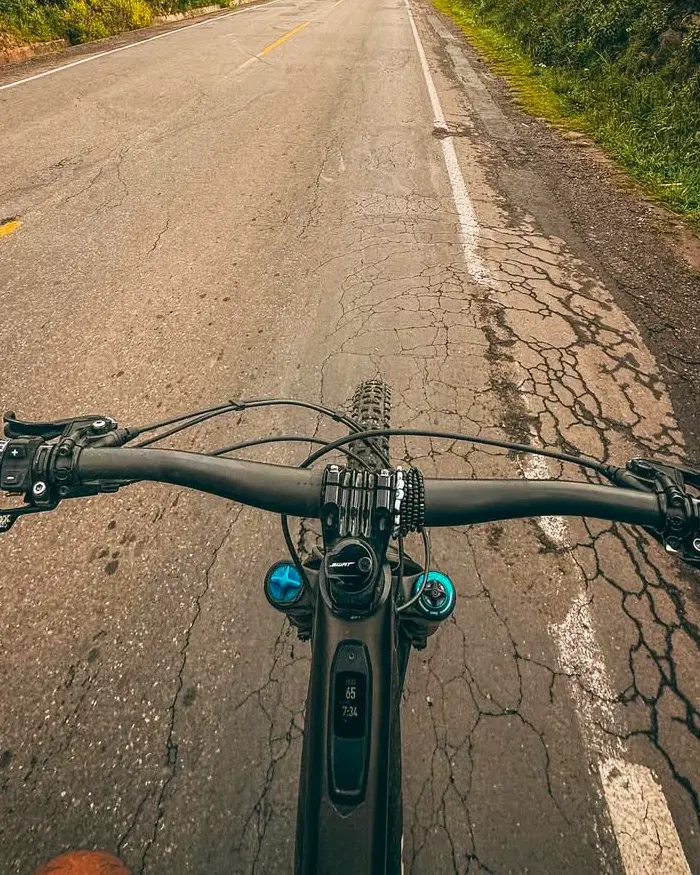
The paved road stretches toward the horizon with a slight incline, creating the feeling of a calm route.
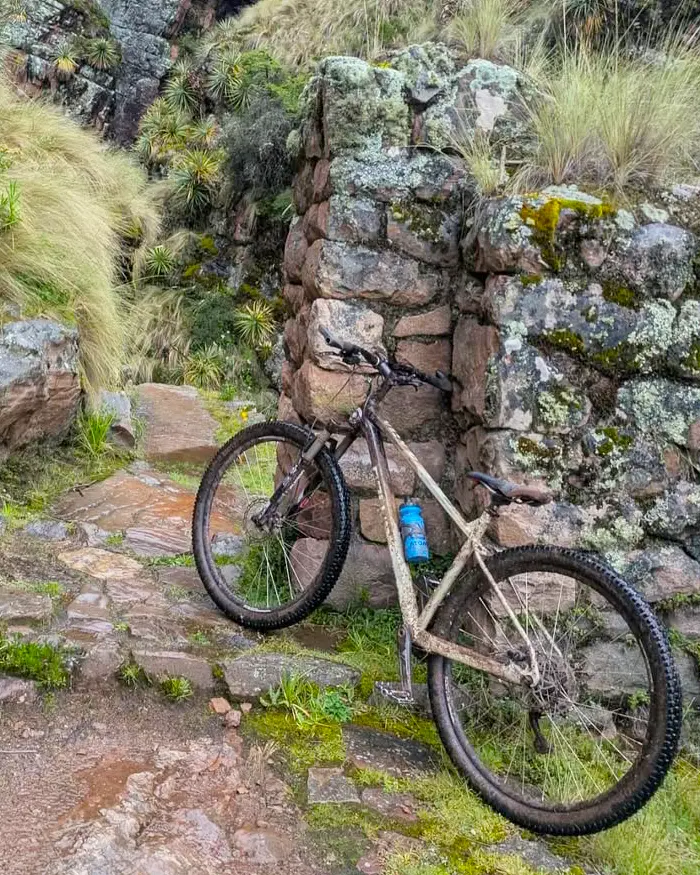
The bike suggests that the rider has just come through demanding terrain, possibly wet and technical.
Features that ideal MTB tires should have in Cusco
When choosing Ideal MTB tires in Cusco, it is important to think about several characteristics that will affect control, safety, and overall performance on Andean trails. You also need to keep dust, loose gravel, and uneven roads in mind. Because of that, your tires should offer the following:
Tire width
Wider tires usually provide more stability on loose terrain. In modern mountain biking, it is common to use tires between 2.3 and 2.5 inches wide, since they give you a larger contact patch with the ground.
Tread pattern
Tread pattern is one of the most important factors when riding in Cusco. Tires with more pronounced and more widely spaced knobs allow the tire to bite better into loose terrain, which improves traction in dust.
Tire volume
Tire volume also plays an important role, especially on routes with rocky or uneven terrain.
Rubber compound
The rubber compound affects both grip and durability. Softer compounds give you more traction, especially on descents and in corners, while harder compounds usually last longer and resist wear better.
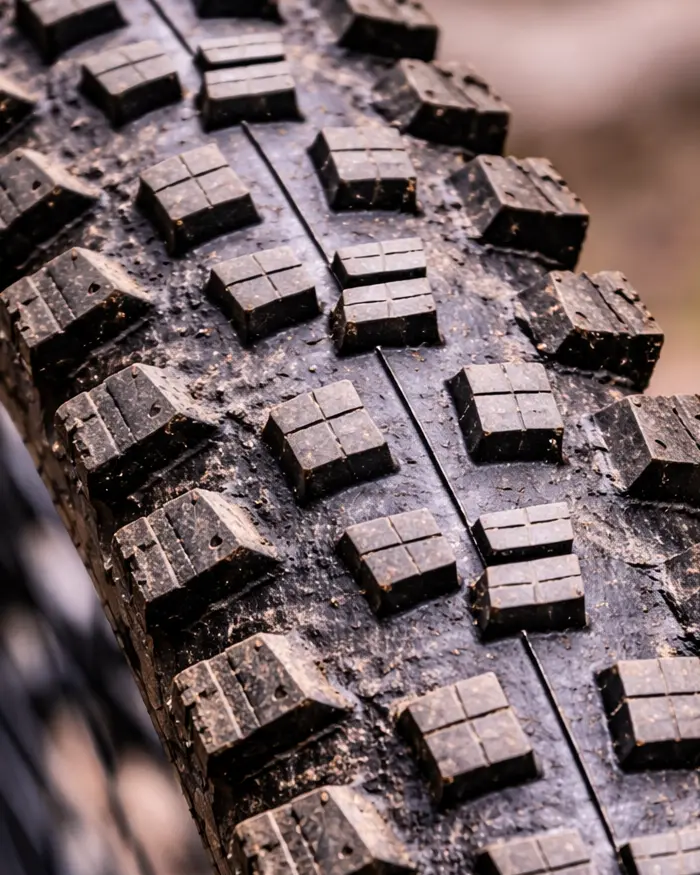
The center knobs look large, firm, and clearly defined, suggesting a tire built to offer good traction on demanding terrain.
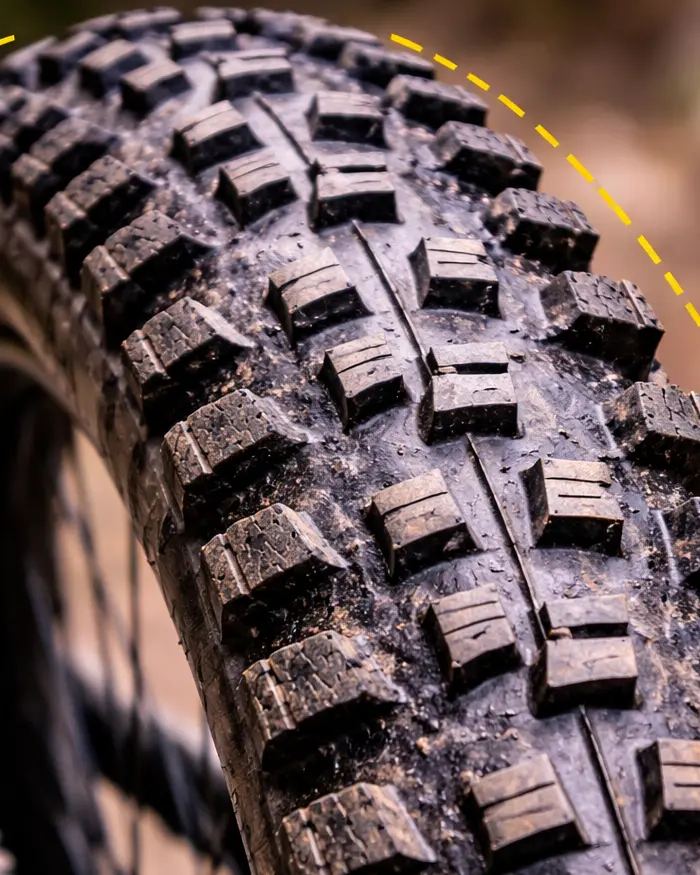
The tread appears in close detail, letting you clearly see the large, defined knobs covering the entire surface.
Did you know…?
On high altitude routes, the terrain can dry out in just a few hours, completely changing the level of grip.
Types of tires that work best for MTB in Cusco
Trail tires
Trail tires are usually one of the most balanced options for riding in Cusco. They combine good grip with acceptable rolling speed, which makes them work very well on varied routes where you will find dust, gravel, and moderately rocky sections.
Enduro tires
Enduro tires give you more traction, stability, and durability. They usually have a more aggressive tread and a stronger casing, which makes them ideal for technical descents, rocky trails, and loose terrain.
Cross country tires
Cross country tires are lighter and faster, so they favor more efficient pedaling. They work better on less technical roads, more compact routes, or rides where speed matters more than grip.
Which option is usually more recommended in Cusco
For most travelers, trail tires are usually the most versatile option because they adapt well to changing Andean conditions. If your route includes more aggressive descents or technical trails, enduro tires usually give you more security.
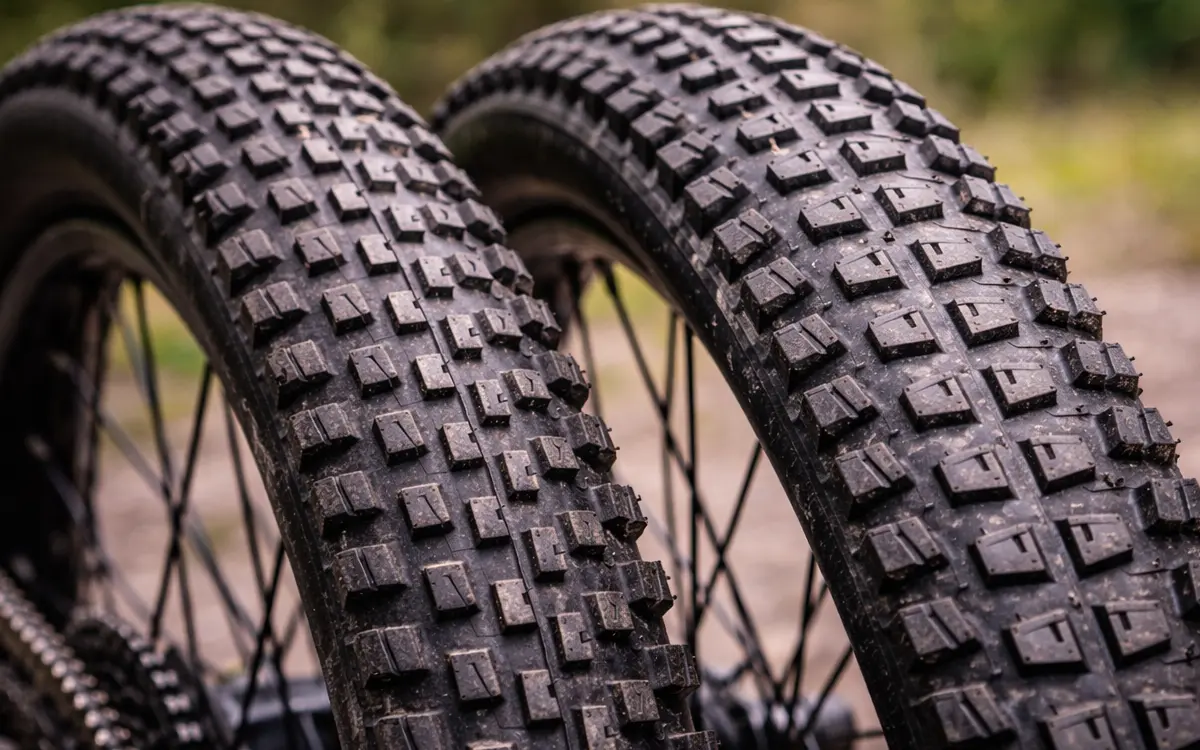
The main focus is on the tire knobs, which are smaller and more compact.
Why do many cyclists use different tires front and rear?
Many experienced mountain bikers use different tires on the front and rear wheels to achieve a better balance of control, traction, and pedaling efficiency.
The front wheel controls direction
The front wheel is responsible for guiding your bike and maintaining stability in corners and descents. That is why many cyclists choose a front tire with more aggressive tread and stronger side grip. This type of tire helps the wheel bite into the terrain more effectively.
The rear wheel has a bigger impact on speed
The rear wheel plays a different role. It is the one that transfers your pedaling force to the ground, so its efficiency directly affects your speed and the effort you make when climbing or riding on flatter terrain.
A better balance between grip and efficiency
Using different tires lets you achieve a better balance between traction and speed. A front tire with good grip improves your safety in corners and descents, while a faster rear tire makes pedaling easier on longer stretches.
A practical setup to make it easy to understand:
- Front: more grip and better side support for corners and descents.
- Rear: a little faster so pedaling does not feel as demanding.
- Result: more control without making the bike unnecessarily heavy or slow.
Ideal tire pressure for riding in Cusco
This is one of the factors that most affects how the bike behaves in the mountains, and remember that adjusting pressure correctly can improve traction, cornering control, and stability on descents.
How pressure affects traction
Tire pressure determines how much contact the tire has with the ground. When you use slightly lower pressure, the tire adapts better to irregular terrain, which increases the contact patch and improves traction.
What happens when pressure is too high
When tires have too much pressure, the contact area with the ground becomes smaller. This can make your bike bounce more on uneven terrain and lose traction in corners or descents.
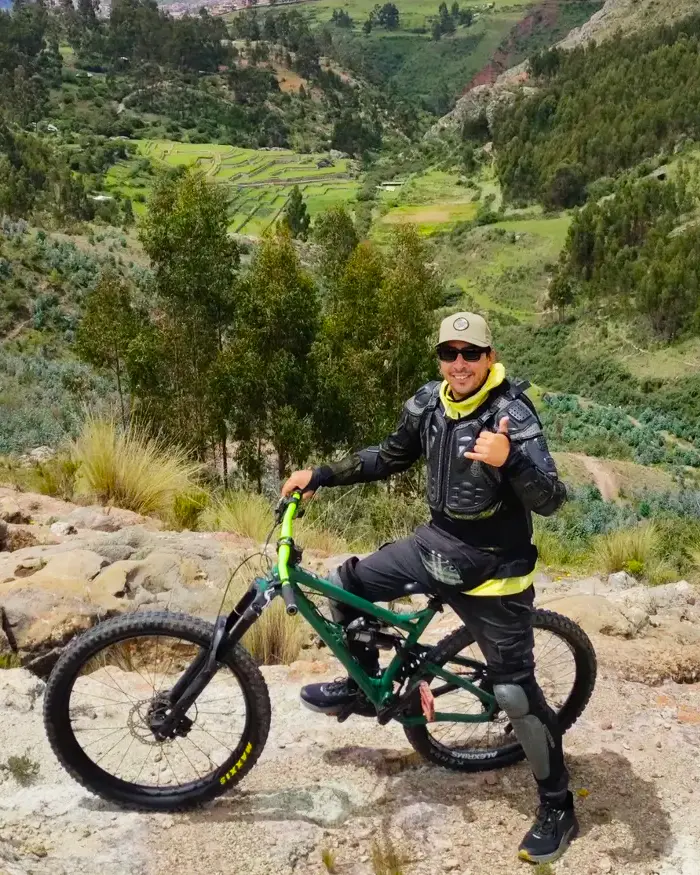
In the background, you can see a wide valley with agricultural terraces and green vegetation.
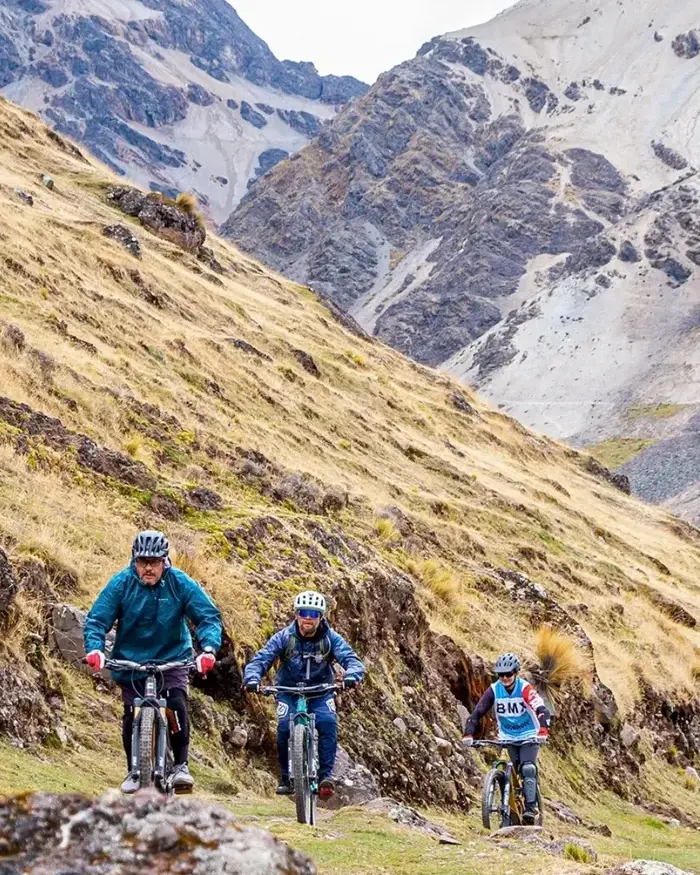
The riders wear helmets and technical clothing suited to cold, changing mountain conditions.
How do the seasons affect MTB terrain in Cusco?
| Season | Approximate months | What the terrain is usually like | How it affects tires |
| Dry season | April to October | Trails with loose dust, gravel, and dry terrain | The tire can lose traction more easily in corners or descents if it does not have good side grip |
| Rainy season | November to March | Wetter, more slippery terrain, and in some cases mud | Mud or moisture can reduce grip and make the bike feel less stable |
| High altitude routes | All year | The ground can dry quickly because of altitude and solar radiation | Even during the rainy season, some routes return quickly to dry conditions |
Keep in mind:
Terrain in Cusco changes constantly, so there is no single perfect tire for everything.
What to check if you are renting a bike in Cusco
Planning to rent a bike in Cusco? Learn what to check before riding so you can secure your MTB experience with more confidence and safety.
Tire condition
The first thing you should check is the condition of the tread. MTB tires need enough pattern to give you good traction on loose terrain, gravel, or dust.
Tire pressure
It is also important to check tire pressure before heading out. In many workshops or rental shops, they inflate them to standard pressures to avoid flats, but on mountain routes, pressure that is too high can reduce traction.
Tubeless or tube setup
If possible, ask whether the bike uses a tubeless system. This system does not use an inner tube and instead relies on sealant liquid that can automatically close small punctures.
Tire size and type
It is also worth checking the tire width and type on the bike. On many modern trail or enduro bikes, it is common to find tires between 2.3 and 2.5 inches wide, since they offer better stability on uneven terrain.

Both tires feature aggressive tread, which suggests they are designed for technical and demanding terrain.
MTB routes in Cusco where tires make a real difference
In the Cusco region, there are several mountain biking routes where the type of tire can strongly affect your safety, control, and the overall riding experience.
Sacred Valley routes
Routes in the Sacred Valley, such as those connecting Maras, Moray, and the Salt Mines, are very popular among cyclists and travelers. These roads usually combine fast stretches of hard packed dirt with gravel sections and corners filled with loose dust.
Routes toward Maras and Moray
On routes at higher elevation, often above 11,500 feet (3,500 meters) above sea level, the terrain can become more technical. It is common to find loose rocks, natural steps, and steeper descents.
High mountain trails
Many MTB rides in Cusco use old rural roads that connect Andean communities. These roads may include hard packed dirt sections, loose rock stretches, or areas where the terrain changes very quickly.
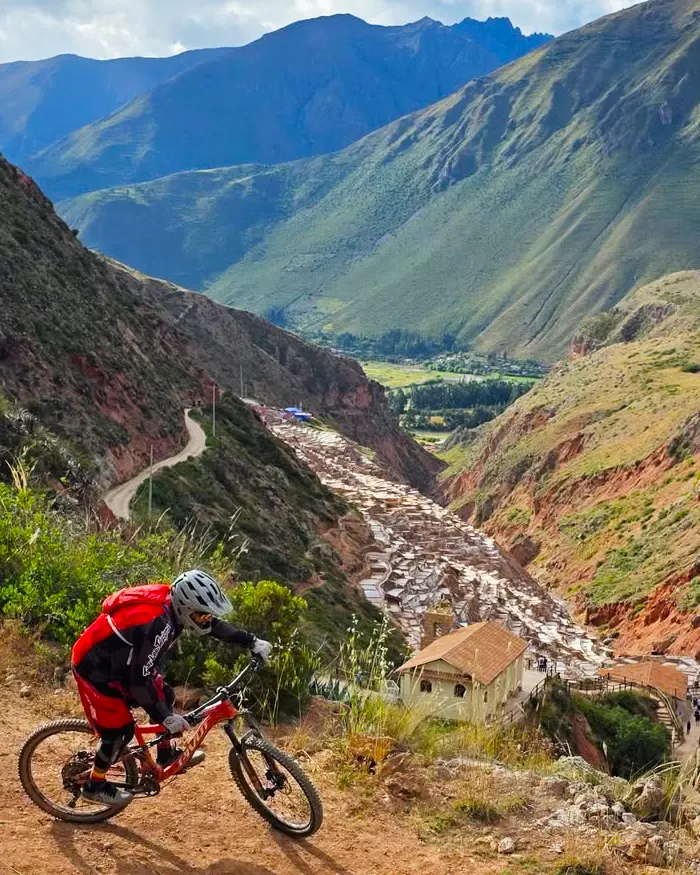
The green mountains surrounding the scene create a spectacular contrast between the vegetation and the salt formations of Maras.
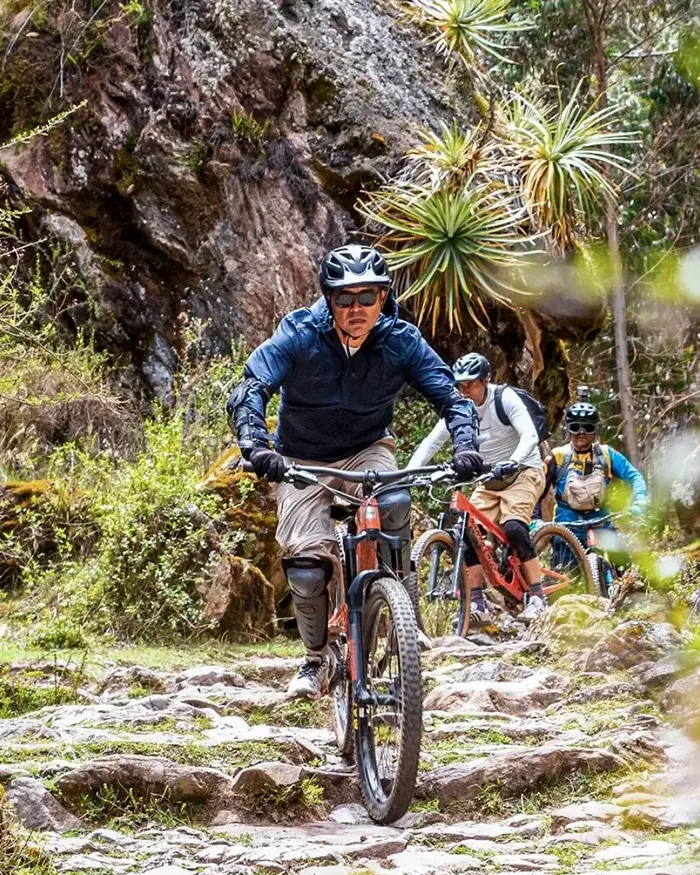
The trail features elevation changes and uneven surfaces that demand control, balance, and good line choice.
Common tire mistakes travelers make
- Using tires that are too narrow
- Overinflating the tires
- Using tires with too little tread
- Riding on heavily worn tires
- Not checking tire condition before the ride
- Not adjusting pressure to match the terrain
- Using the same type of tire for every kind of route
- Not checking for cuts or damage in the tire
Choosing the right MTB tires for Cusco is not a minor detail, because it directly affects your traction, stability, and safety on Andean trails. When you understand what the terrain is like, which type of tire suits you best, and how to set up your bike properly, you can enjoy every route much more.
Thousands of travelers have trusted Peru Biking Tours to enjoy unforgettable experiences in the Andes.
Your safety comes first
Routes adapted to your level, expert local guides, and full support at every stage.
No worries at all
We take care of all the logistics so you can focus entirely on enjoying the scenery.
Authentic routes in Cusco
Experience the Sacred Valley in a real way, at your own pace, with access to the best trails.
High quality equipment
High end enduro bikes, helmets, and protective gear for all levels.
Plan your MTB experience in Cusco
MTB Day Tours in Cusco
If you want to ride routes like Lamay Sapacto with the right logistics, local support, and the right trail selection, check out our MTB Day Tours in Cusco.
Multi-Day MTB Tours
For more complete experiences that connect multiple valleys and high mountain routes, explore our Multi-Day MTB Tours.


