



Quick Answer:
Altitude does not directly “kill” an E Bike battery, but the mountain conditions around it do. In the Andes, cold weather can reduce battery performance, long climbs consume far more energy than distance alone, and sustained high assistance can make the motor cut power temporarily to protect itself. At altitude, real range depends more on elevation gain, temperature, rider input, and assist mode than on kilometers alone.
Understanding how altitude affects E-Bikes in the Andes is essential before riding in Cusco. The altitude itself does not directly “kill” battery range, but the combination of cold weather, long sustained climbs, and thin air changes how the battery, motor, tires, and suspension behave. In mountain terrain, real E Bike range depends more on elevation gain, temperature, rider weight, and assist mode than on distance alone.
Curious how altitude impacts your E-bike in Cusco? Our day tours are designed for riders who want authentic adventures in the Andes, always smoother when you understand how battery, motor, and range respond at high elevation.
Thanks to electric assistance, Andean routes that before only high performance cyclists could tackle are now within reach of more people. However, this advance brings an important challenge, battery range is no longer a fixed value, but depends on factors like grade, climate, cyclist weight and terrain type. That’s why each outing requires careful planning to ensure both safety and excursion success.
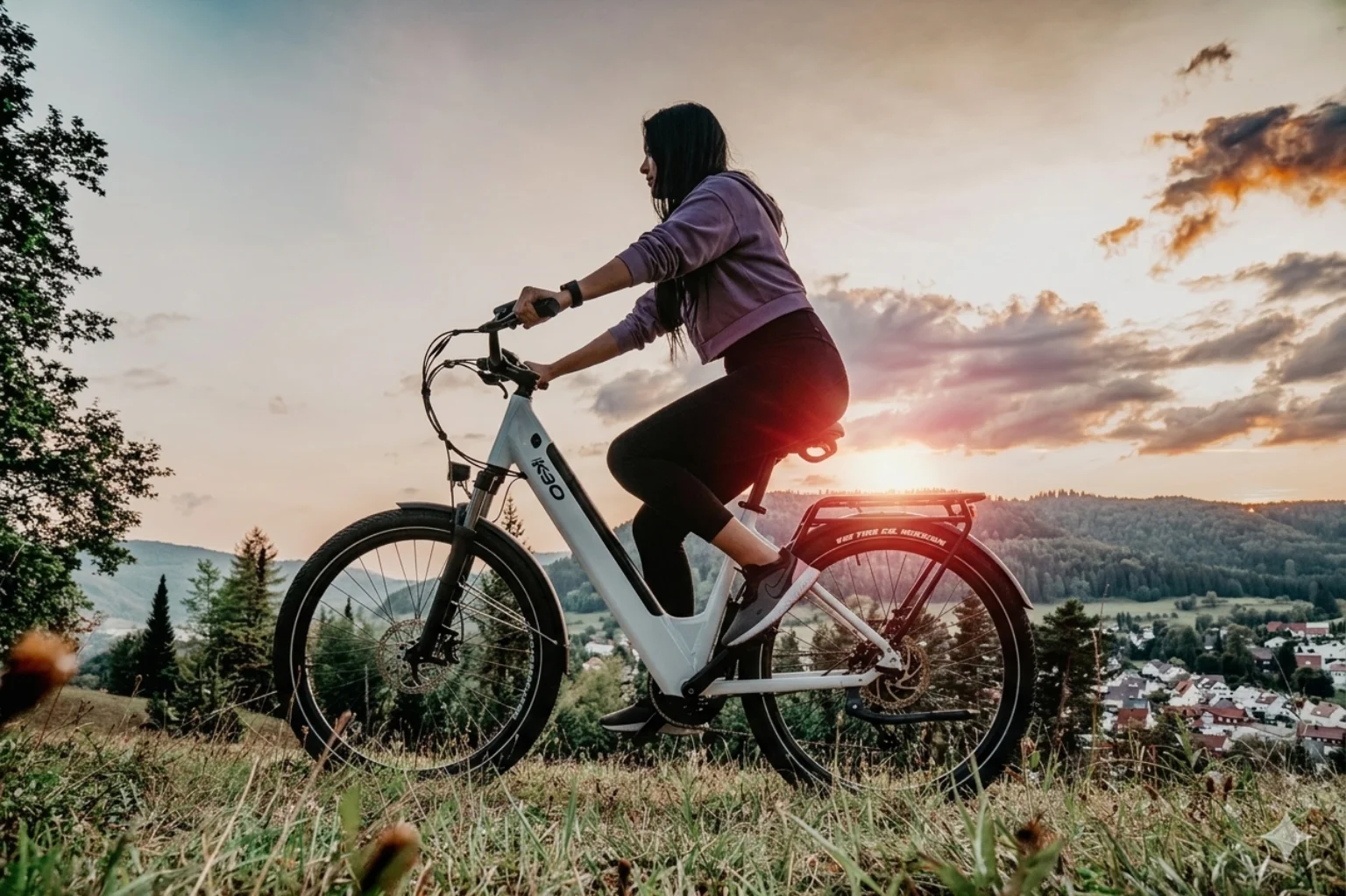
E-Bike Rider at Sunset Overlooking a Valley
How altitude affects E-Bikes in the Andes?
It’s not the altitude, but the combo that accompanies it: endless climbs triple consumption, cold blocks up to 20% of battery and thin air overheats motor, wasting energy. Your range drastically reduces even though gauge shows the same.
How much battery does an E-Bike use on long climbs?
Knowing how much battery you have left isn’t a matter of luck, it’s pure physics. On Andean routes like Cusco, the screen indicator can be misleading. Here we explain how to calculate your real consumption based on variables that truly matter.
Terrain challenge: On high mountain routes, energy consumption isn’t linear. Constant effort to overcome gravity on steep grades drains battery much faster than on flat terrain, even if distance covered is short.
Realistic range expectations:
- Intensive use (Throttle only/Constant Turbo mode): Range drastically reduces to about 25-37 miles (40-60 km).
- Efficient use (Pedal assist/Eco or Tour mode): If cyclist contributes physical power, range can extend to 43-62 miles (70-100 km).
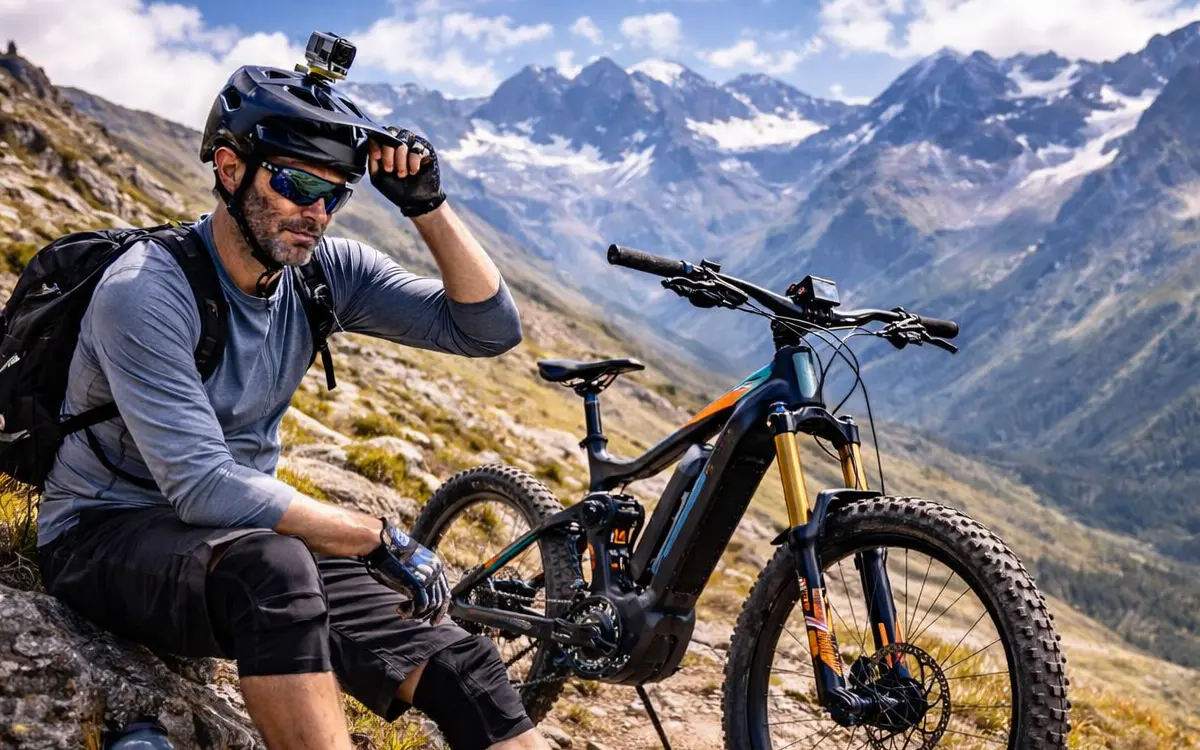
Cyclist on Andean trail resting after prolonged ascent, showing relationship between altitude and fatigue.
Strategy:
Planning is vital. Study route elevation profile and identify points where you can recharge or, at least, flat sections where you can turn off assistance to conserve energy.
Cold and real battery performance
Lithium ion batteries are temperature sensitive, and altitude usually comes with intense cold.
- Internal chemistry: With cold, battery cell internal resistance increases. Lithium ions move more slowly, preventing battery from delivering all its theoretical capacity.
- Real impact: You can experience a “phantom loss” of energy. Range can drop between 20% and 30% simply from being near 32°F (0°C), even if battery was charged to 100%.
E-Bike Ride by the Beach at Sunset
Expert tip:
Storage temperature is key. If you’re going to overnight at altitude, remove battery from bike and store it inside your sleeping bag or in a heated place. Install it on bike just before starting to ride. A warm battery performs much better than a cold one.
Motor, heat and temporary assistance loss
A technical aspect often ignored is air density.
- Physical problem: At 16,404 feet (5,000 meters), air is much less dense. Though electric motors don’t need oxygen for combustion, they do need air to cool. With fewer air molecules hitting motor casings, heat dissipation is less efficient.
- Overheating risk: If you demand maximum power for a long time at altitude, motor could enter thermal protection mode and automatically reduce power.

E-Bike Mid-Drive Motor Close-Up
Recommendation:
Alternate intensity. Don’t abuse “Turbo” mode continuously. Allow system to cool by lowering assistance on less inclined sections and contributing more force with your legs.
Neumatic Behavior: Suspension and Tires
Though not part of electrical system per se, components using air directly affect motor efficiency and handling feel (ride quality).
|
Aspect
|
Details
|
|
🔬
The Physics of Pressure |
When climbing from coast to Andes, external atmospheric pressure decreases, which makes your tires and air suspension relative internal pressure increase.
|
|
⚠️
Performance Effect |
🛞 Tires:
A tire feeling normal in Lima can be hard as a rock in Cusco, reducing traction and transferring more vibration to frame and motor. 🔧 Suspension:
Fork and shock can become stiffer and more bouncy, affecting control. |
|
🔧
Necessary Adjustment |
✅ CRITICAL:
It’s vital to purge (reduce) pressure slightly upon arriving at altitude to recover grip and comfort, which in turn allows smoother and more efficient pedaling for motor. |
Altitude Impact on E-Bike Systems
We often focus on how lack of oxygen affects the cyclist, but above 9,843 feet (3,000 meters), physics changes for the machine too. Altitude impacts your electric bike components in subtle but critical ways, going far beyond simple battery duration.
Motor Thermodynamics
|
Technical Aspect
|
Explanation
|
|
⚙️
Physical Principle |
Mid-drive motors from leading brands (Bosch, Shimano, Brose, Yamaha) depend on air convection to dissipate heat generated by friction and electrical resistance. At sea level, air is dense and acts as an effective coolant.
|
|
🏔️
Reality in Cusco (11,155 ft/3,400 m) |
At this altitude, atmospheric pressure is approximately 30% lower. This means fewer air molecules hitting motor cooling fins, drastically reducing its capacity to transfer and dissipate accumulated heat.
|
|
🌡️
Practical Consequences (Thermal Throttling) |
• On long sustained climbs, motor will reach its critical temperature much sooner than at sea level. • Modern systems are smart: they have thermal sensors that activate thermal throttling. System will automatically reduce power delivery to protect itself, which cyclist will perceive as sudden assistance loss. |
|
✅
Verdict for Cusco Tours |
For vast majority of tourist tours, which prioritize descent or mixed terrain with intermittent motor use, this isn’t a problem. Motor has plenty of time to cool. However, on multi-day expeditions with aggressive continuous climbs, it’s a crucial factor to manage. |
Electronic Immunity: Displays and Sensors
Amid these physical variables, pure electronics is the most robust component.
|
Component
|
Why it’s not affected
|
|
📱
Displays and Controls |
✅ FULLY FUNCTIONAL:
LCD, LED or TFT displays don’t suffer degradation from low pressure. Visibility and functionality remain intact. |
|
🎯
Internal Sensors |
✅ IMMUNE TO ALTITUDE:
Torque sensors (measuring your force), cadence (your revolutions per minute) and speed (magnets on wheel) are solid state or magnetic systems. 🔬 Technical Reason:
Having no parts depending on air density or fluids that expand, they’re immune to altitude. Their precision on a mountain pass at 16,404 feet (5,000 meters) is identical to what they’d have at the beach. |
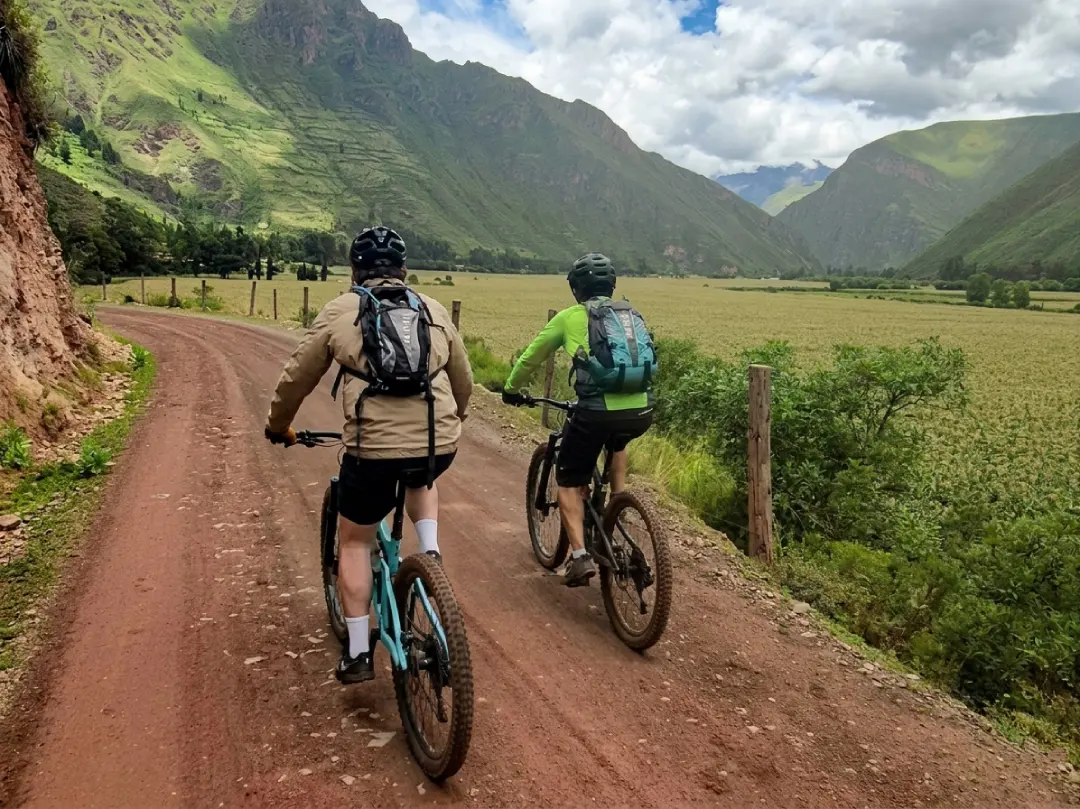
Two Cyclists Riding in the Sacred Valley of Cusco
Positive Elevation
Forget flat kilometers; in mountains, what consumes battery is fighting gravity.
- Dominant Factor: Every meter you climb costs energy. Steeper the hill, more amps motor “sucks.”
- Magic Formula: Calculate approximate consumption of 20 Wh per 328 feet (100 meters) of positive elevation (can vary 15-25 Wh depending on weight and assistance).
- Quick example: If you’re going to climb 2,625 feet (800 meters) on a route, just that climb will cost you about 160 Wh. If you have a 500 Wh battery, you’ll have 340 Wh left for rest of journey.
Tips to maximize battery on steep climbs
Riding style is number one factor in battery conservation during long ascents.
- Effort management: On constant climbs (mountain passes), electric motor is under continuous load.
- Optimization: Avoid temptation to use maximum assistance all the time. Use mechanical gears (large cogs) to maintain high pedaling cadence (70-90 rpm). Electric motors are more efficient at high cadences; if you’re “stuck” in a hard gear, motor works harder and consumes more amps.
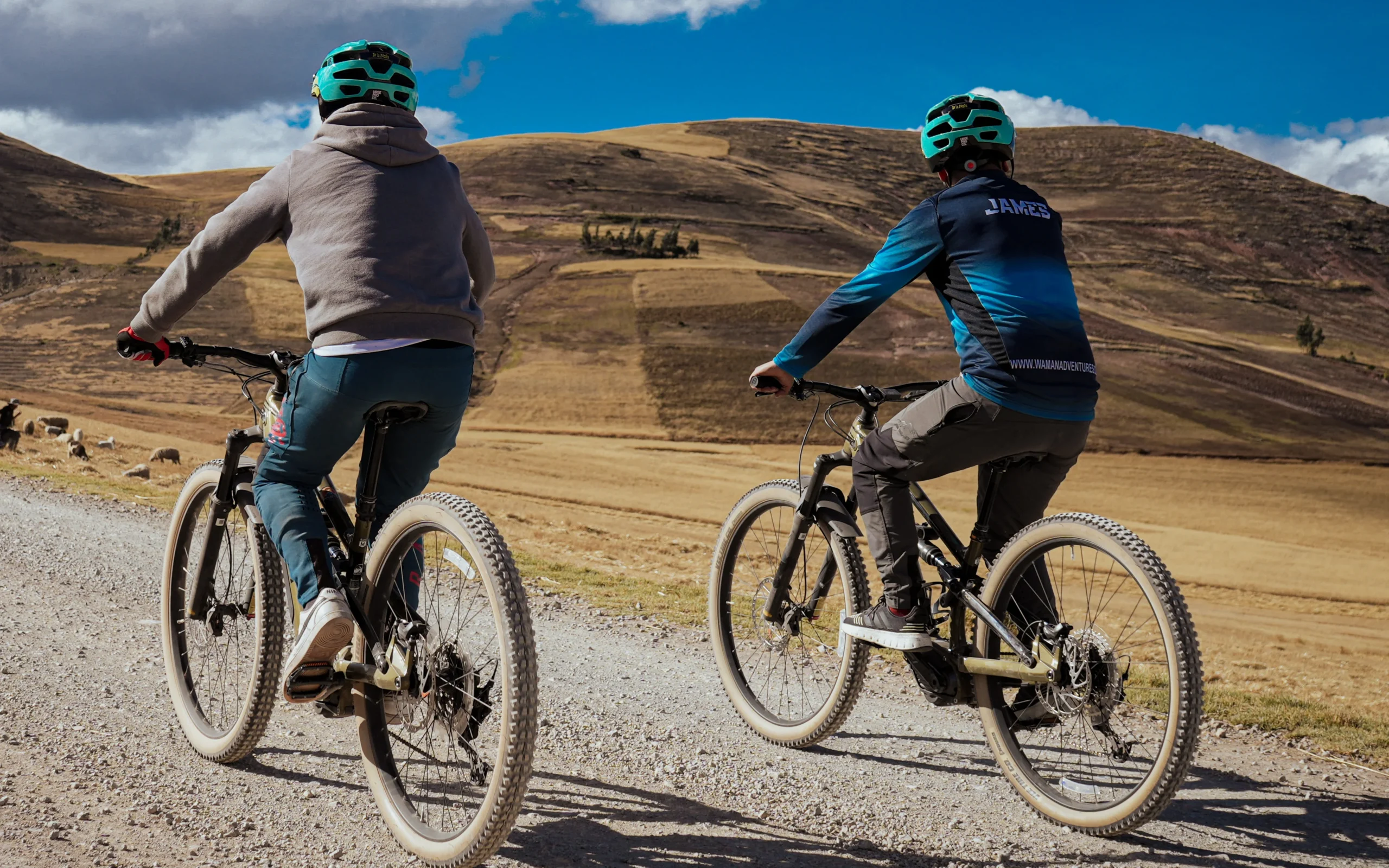
Sacred Valley roads, MTB spirit, Cusco scenery in full view.
Electric Bike Advantages at Altitude
Despite technical challenges, electric bike advantages at altitude outweigh any inconvenience:
- Active Acclimatization: Allows gentle routes during your first Cusco days without raising heart rate to dangerous levels.
- Extended Exploration: You can visit three lagoons in one morning, something that on conventional bike would take all day and strenuous physical effort.
- Adventure Democratization: Allows groups of different fitness levels to pedal together, keeping group united on climbs.
Common mistakes using an E Bike in the Andes
- Measuring battery range by kilometers instead of elevation gain.
- Starting with a cold battery on freezing mornings.
- Using Turbo mode continuously on long climbs.
- Ignoring tire and suspension pressure after gaining altitude.
- Pedaling in a hard gear at very low cadence, which makes the motor work less efficiently.
Plan your MTB experience in Cusco
MTB Day Tours in Cusco
If you want to explore MTB routes with the right logistics, local support, and suitable trail selection, check out our MTB Day Tours in Cusco.
E-bikes Tours
Curious how altitude impacts your e-bike in Cusco? Our E-Bike tours are designed for riders who want authentic enduro adventures in the Andes.


