


Quick Answer:
The Enduro from Cusco to Huchuy Qosqo is a full day, high altitude point to point ride for experienced mountain bikers. It combines pedaling, long natural descents, constant terrain reading, and a cultural finish at one of the Sacred Valley’s most important Inca sites. It is best suited to riders who already feel comfortable on natural singletrack above 11,500 ft (3,500 m)
Enduro might sound straightforward, but once you ride in Cusco, you realize it is a completely different game. The Enduro route from Cusco to Huchuy Qosqo is not a bike park or a short descent. Here, you pedal at altitude, the terrain is natural and constantly changing, and every section demands that you read your line carefully to stay in control. On top of that, this route connects the mountains with the Sacred Valley and finishes at an Inca site, adding a unique cultural dimension to the experience. In this guide, you will discover where the route begins, what the terrain is like, how long it actually takes, and the best season to ride it.
🏔️ Key Facts — Enduro Cusco → Huchuy Qosqo
Where the Enduro from Cusco to Huchuy Qosqo begins?
The Enduro route from Cusco to Huchuy Qosqo starts in the upper part of the city, typically between 11,500 and at around 11,975 feet (3,650 meters) From there, you quickly enter the mountains via open roads, community trails, and ancient routes that historically connected Cusco with the Sacred Valley.
Starting at that elevation defines the entire character of the ride. From the very first miles, you need to adapt to thinner air, control your breathing, and manage your energy carefully. These starting points also offer wide open views of Cusco and the surrounding peaks, helping you visualize the scale of the journey ahead.
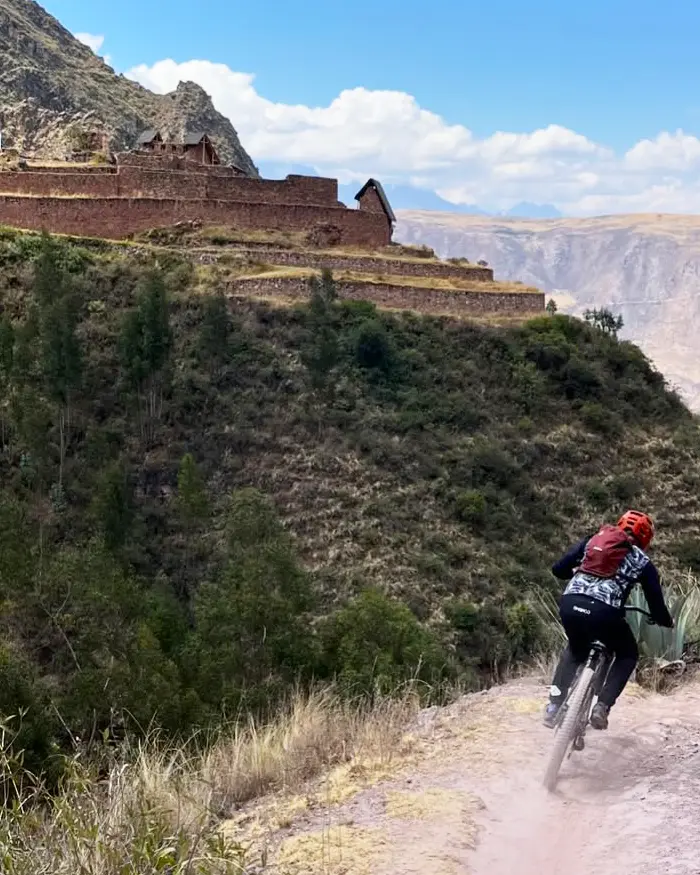
The trail line is narrow and technical, with exposure that demands full concentration.

The rider wears a helmet, backpack, and technical gear, ready for a long and demanding descent.
Where Huchuy Qosqo is located and why arriving by enduro is different?
Huchuy Qosqo sits on a high plateau above the Sacred Valley of the Incas, between the districts of Lamay and Calca, at 11,800 feet (3,600 meters). Its strategic location is no coincidence. During the Inca period, it served as an important administrative and residential center.
Most visitors reach Huchuy Qosqo on foot, starting from Sacred Valley communities like Lamay. That approach allows you to appreciate the archaeological site, but arriving by enduro from Cusco completely changes the experience.
By riding from Cusco, you follow the same geographic corridor that once connected the city to the valley, crossing high altitude terrain, open slopes, and trails that gradually descend toward the Sacred Valley.
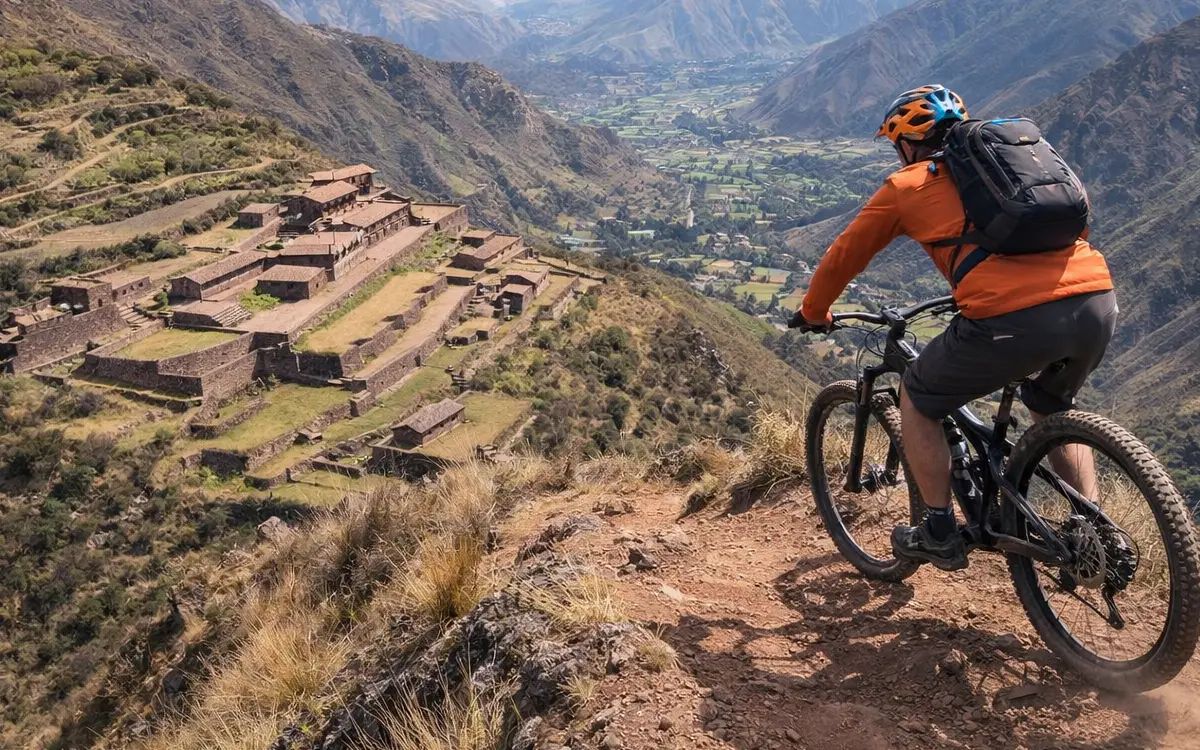
Huchuy Qosqo takes you along ancestral paths surrounded by terraces and Inca architecture.
Why this is Enduro and not Downhill?
To understand why this route is enduro and not downhill, keep these key ideas in mind:
It requires constant pedaling
From the start, you will be pedaling at altitude, especially in the first section. You do not get dropped at the top and simply ride down.
The elevation changes gradually
You will climb and descend throughout the route, so you need endurance and solid pacing.
You ride for several hours
This is not a short, intense descent. It is a long traverse that demands sustained focus and control.
The terrain is natural and minimally altered
You will not find built berms, jumps, or maintained features like in a downhill bike park.
Terrain reading is constant
The surface shifts between compact dirt, dust, gravel, rock, and uneven steps, requiring constant technique adjustments.
Speed is not the main goal
Control, flow, and safety matter more than going as fast as possible.
Altitude affects performance
Riding above 11,500 feet (3,500 meters) makes energy management a central part of the experience.
The route connects mountain, city, and valley
It is a full journey linking Cusco with the Sacred Valley, something that defines enduro rather than downhill.
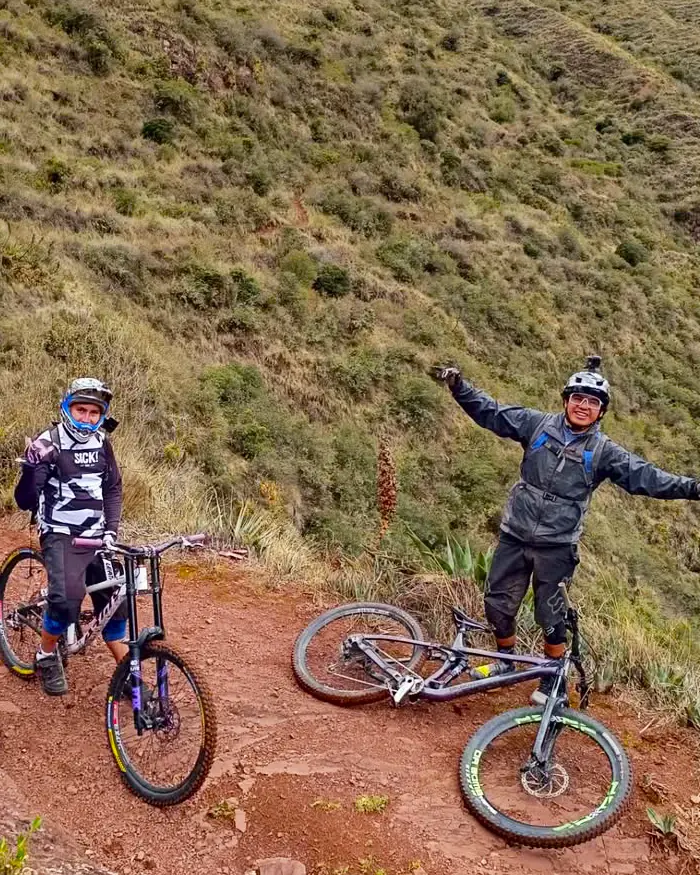
Cloudy skies create a cool, typical high altitude Andean atmosphere.
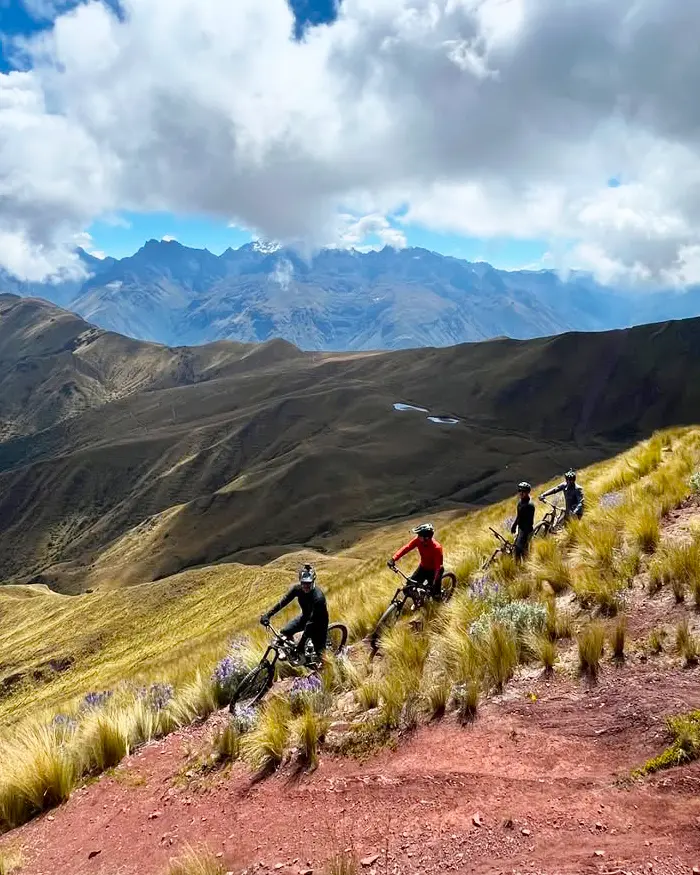
Sparse vegetation and uneven terrain highlight the natural, untouched character of the route.
What the terrain is like on the Enduro from Cusco to Huchuy Qosqo?
The terrain on the Enduro from Cusco to Huchuy Qosqo is one of the main factors that defines both the experience and the real difficulty of the route. It is not technical in the sense of jumps or man made features, but it is demanding because of its variety, irregularity, and length, so you will need to stay focused for hours.
You will encounter constantly changing surfaces, and that is where terrain reading becomes essential. One defining feature is the presence of uneven Inca steps and narrow trails. These were not built for bikes but as ancient pathways, so the height and spacing of the steps vary, forcing you to descend with control.
There are also exposed sections with drop offs toward valleys or open slopes. They are not constant, but they appear often enough that you need to stay alert, especially when the ground is loose or wet.
Pro tip:
Keep your weight slightly back on uneven steps to avoid overloading the front wheel.
Real difficulty level of the route
| Key factor | How it affects difficulty | What it means for you as a rider |
| Altitude | Riding between 11,500 and 12,500 feet (3,500–3,800 meters) | You fatigue faster, breathe harder, and your reaction time drops |
| Total distance | Long route, typically several hours | You need endurance and pacing, not just technical skills |
| Accumulated fatigue | Effort is sustained throughout the ride | Mistakes tend to happen toward the end when you are tired |
| Terrain type | Natural, irregular, and constantly changing | You must read the ground continuously and adjust your line |
| Weather and wind | Changes quickly at altitude | It can affect your energy and focus |
| Effort profile | No vehicle access to the start | You gain all elevation through pedaling |
Who this route is really for?
| Rider profile | Fit |
| Beginner MTB rider | No |
| Intermediate rider with altitude experience | Maybe |
| Advanced natural trail rider | Yes |
| Bike park rider with little endurance | Maybe not |
| E-bike rider with good planning | Possible |
How long the Enduro from Cusco to Huchuy Qosqo takes?
The Enduro from Cusco to Huchuy Qosqo typically takes between 5 and 7 hours and should be planned as a full day in the mountains. This is not a short ride or something comparable to a casual half day outing.
It depends on these factors:
- Starting point
- Group pace
- Terrain conditions
- Necessary stops
Not sure if this route matches your level?
Tell us about your riding experience, how many days you have spent in Cusco, and how you feel at high altitude effort. We will give you an honest recommendation.
Best season and best time of day
| Key aspect | Dry season | Rainy season |
| Trail condition | Firm, with fine dust | Mud, wet rock, and soft ground |
| Traction level | Moderate, lower in corners due to dust | Low and inconsistent, especially on rock |
| Terrain readability | Clearer and more predictable | More demanding due to moisture and rapid changes |
| Average speed | Moderate, with good control | Lower, more technical focus |
| Overall risk | Moderate and manageable | Higher, especially with fatigue |
| Ideal for intermediate riders | Yes | Not recommended |
| Ideal for advanced riders | Yes | Only with experience and stable weather |
| Daytime weather | Stable and dry | Variable, frequent rain |
Warning:
If the weather shifts suddenly at altitude, stop and reassess before continuing.
What to bring for the Enduro from Cusco to Huchuy Qosqo?
- Bring a certified helmet in good condition.
- Wear gloves for better control and protection.
- Use knee pads; they are highly recommended here.
- Make sure your mountain bike is in excellent condition.
- If possible, ride a full suspension bike; it is ideal, though not mandatory.
- Use tires suited for mixed terrain (dirt, gravel, and rock).
- Carry enough hydration (at least 3 liters).
- Dress in layers for changing weather.
- Do not forget sun protection (sunscreen, buff, or cap).
- Pack basic tools (multi tool, tube or tubeless kit).
- Bring a basic personal first aid kit.
Why ride the Enduro from Cusco to Huchuy Qosqo with a guide?
- Navigation is not obvious
- Trails change depending on the season
- There are culturally sensitive areas
- Pacing must adapt to high altitude effort
- Better line choice and descents
- More safety in exposed sections
- Better time and energy management
- A smoother, more complete experience
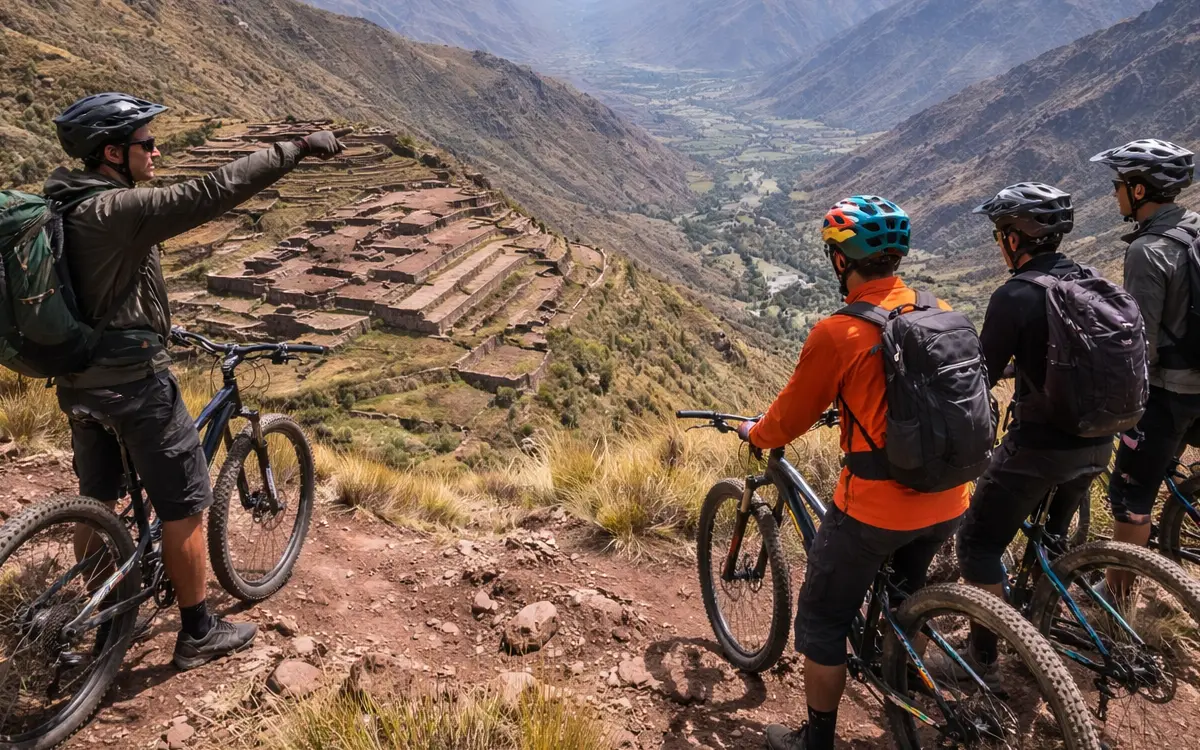
The guide leads the experience, explaining the route and technical sections before the descent begins.
Why this route is one of the most iconic in Cusco?
The Enduro from Cusco to Huchuy Qosqo is one of the most iconic routes in the region because, in a single ride, it brings together everything that defines authentic mountain biking in the Andes. This is not just about pedaling or descending. It is a full journey that connects the city, the mountains, and the Sacred Valley, following natural corridors used since pre Hispanic times.
Riding the Enduro from Cusco to Huchuy Qosqo can be an incredible experience. Because the route is long, natural, and sometimes seasonally variable, most riders get a better experience with local logistical support and a guide who knows the terrain. If you are still unsure whether this route is right for you, at Peru Biking Tours we can guide you so you ride safely and make the most of your trip. Contact us at +51 946 459 491 and start planning your experience in Cusco.
Thousands of travelers have trusted Peru Biking Tours to live unforgettable experiences in the Andes.
Your safety first
Routes adapted to your level, expert local guides and full support at all times.
Without worrying about anything
We take care of all the logistics so you can just focus on enjoying the scenery.
Authentic routes in Cusco
Experience the Sacred Valley in a real way, at your own pace, with access to the best trails.
Quality equipment
High-end enduro bikes, helmets and protective gear for all levels.
Plan your MTB experience in Cusco
MTB Day Tours in Cusco
If you want to explore MTB routes with the right logistics, local support, and suitable trail selection, check out our MTB Day Tours in Cusco.
Multi-Day MTB Tours
For more comprehensive experiences that connect several valleys and high mountain routes, discover our multi-day MTB Tours.


