


Quick Answer:
In Cusco, downhill is pure adrenaline: steep, technical descents where gravity reigns supreme and control is everything. Enduro offers a more complete experience, combining demanding pedaling on Andean trails with long, varied descents. And e-bikes are a game-changer, allowing you to cover more kilometers and reach higher altitudes with less impact from altitude sickness. Choose downhill for speed, enduro for the physical challenge, or e-bike to explore without exhausting yourself.
Cusco is one of South America’s most complete destinations for mountain biking, but not all experiences are equal. Downhill vs Enduro vs E-Bike in Cusco offer very different ways to explore its mountains, valleys, and ancestral roads. Altitude, terrain type, and route duration make choosing the right modality key to enjoying the trip, performing better, and making the most of each descent.
Trying to decide between downhill, enduro, or E-bike in Cusco? Our day tours are designed for riders exploring which Peruvian adventure fits their style best, while still delivering authentic MTB experiences in the Andes.
Downhill vs Enduro vs E-Bike in Cusco, what are they?
Downhill (DH): pure descent
Downhill is cycling focused almost exclusively on descending. You start from high points accessible by vehicle and descend at high speed through technical trails. The bikes are heavy, with full suspension (180-200 mm front and rear) and powerful brakes. You don’t pedal long distances.
In Cusco, downhill takes advantage of natural elevation drops of more than 3,281 feet (1,000 meters), from compacted dirt roads to technical singletrack with loose rocks, exposed roots, and tight corners.
Enduro: balance between climbing and descending
Enduro combines climbs powered by your own effort with long, technical timed descents. It requires better physical condition and prior MTB experience. Enduro bikes have medium suspension (160-180 mm), moderate weight that allows efficient climbing and controlled descending, versatile geometry.
In Cusco, enduro routes typically involve pedaling from 9,186 feet (2,800 meters) to points between 11,483-13,123 feet (3,500-4,000 meters), then descending through technical trails.
E-Bike: assisted exploration
E-Bikes or electric bicycles have a motor that assists pedaling up to speeds of 20-32 km/h (15.5-20 mph), with battery lasting 25-50 miles (40-80 kilometers) that reduces the impact of altitude and long climbs. The system works with torque sensors that detect your pedaling and multiply your effort. On these bikes you must pedal, but the motor significantly reduces effort on climbs.
In Cusco, E-Bikes open routes to people without technical experience, families, and travelers who prioritize landscape and culture over speed.
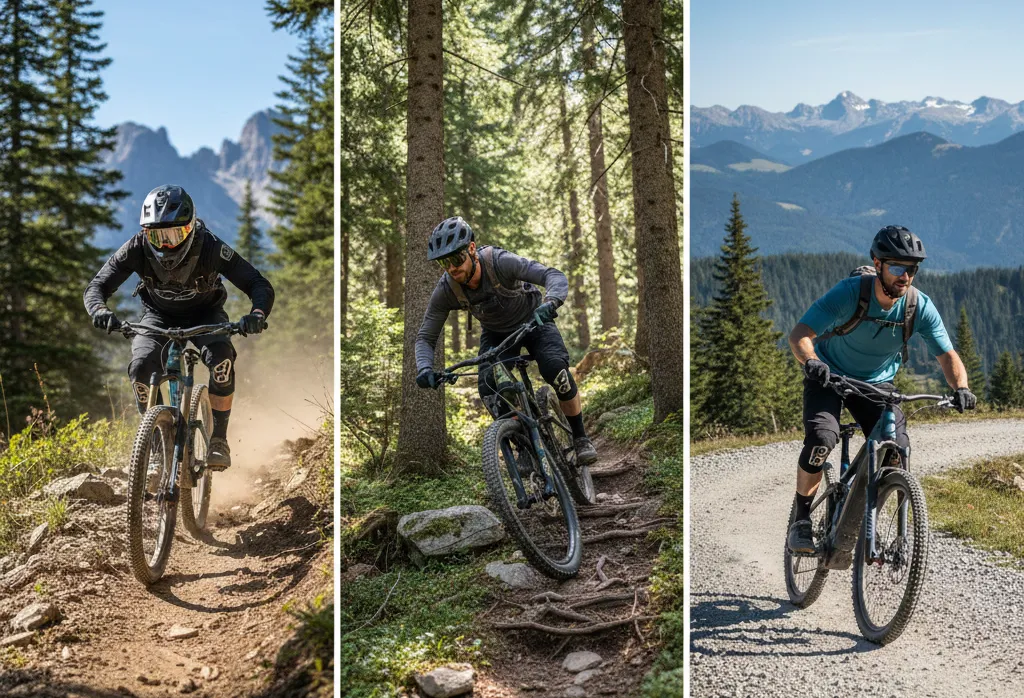
MTB Comparison: Downhill vs Enduro vs E-Bike in Cusco
Differences between Downhill vs Enduro vs E-Bike in Cusco
| Aspect | Downhill | Enduro | E-Bike |
|---|---|---|---|
| Physical effort | Low | High | Medium-low |
| Technical level | Medium–high | High | Low–medium |
| Ideal for | 1 day, adrenaline | Active trips | Families, beginners |
| Altitude | High but short | High and prolonged | Adaptable |
| Typical time | 3–5 hrs | Full day | 3–6 hrs |
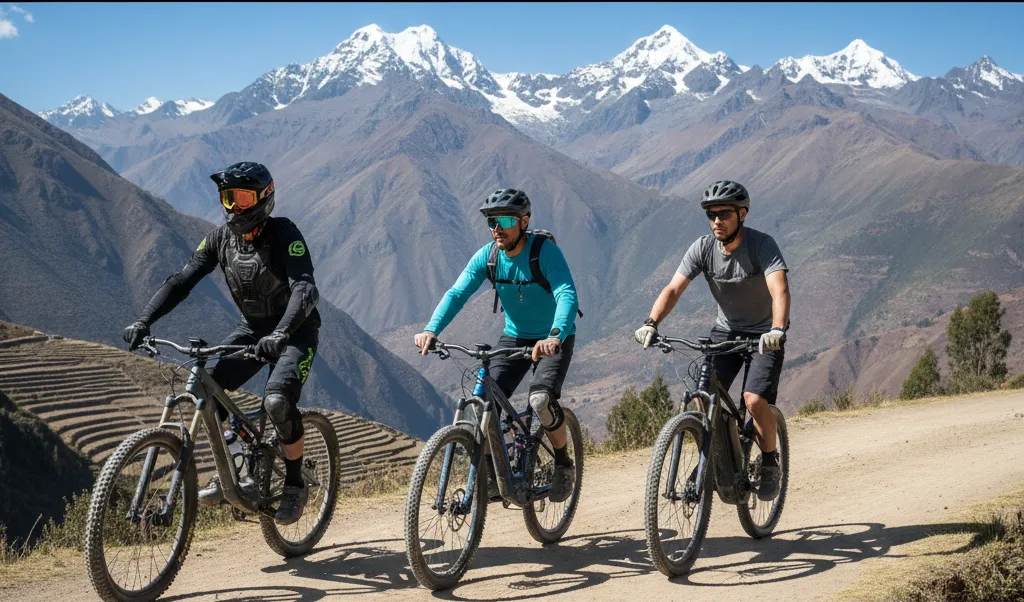
Visual Comparison: Downhill vs Enduro vs E-Bike in Cusco Andes
How to choose the perfect route for you
| Modality | Suspension travel | Terrain type | Style | Recommended level |
| Downhill | 180 to 200 mm | Steep descents, broken terrain, technical corners | Progression and control at speed, shuttle supported descents | Intermediate to expert (route dependent) |
| Enduro | 160 to 180 mm | Natural steps, loose rock, irregular singletrack | Pedal up, descend hard, link multiple stages | Advanced (strong intermediate with guide) |
| E Bike | 130 to 160 mm | Long routes, mixed trails, rolling climbs | Exploration and efficiency, more distance with less fatigue | Beginner to intermediate |
Best routes by modality
Downhill: fast, intense, and accessible
- Yuncaypata – Cusco: Route close to the city, perfect for half day. Moderate technique and open views.
- Huayllarcocha – Cusco: Fluid trails, good balance between control and speed.
- Maras: Lower altitude, ideal for avoiding altitude sickness.
Many downhill routes begin above 12,467 feet (3,800 meters) and end near 9,186 feet (2,800 meters).
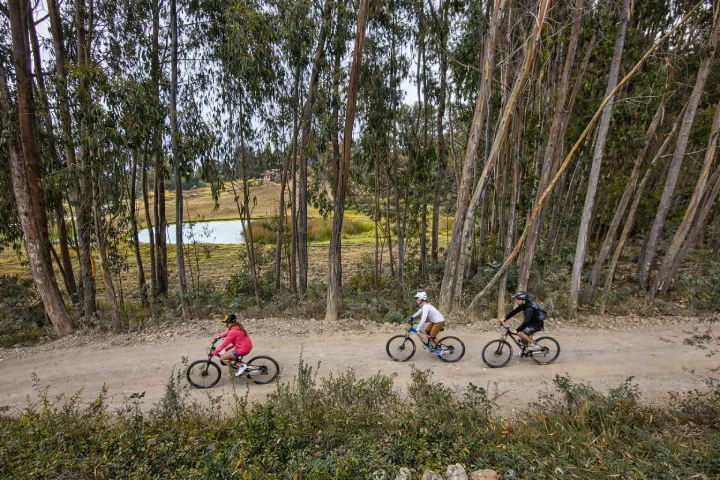
Huayllarcocha Downhill Route: Mountain Biking Next to Lagoon in Cusco
Enduro: for those seeking challenge
- Enduro MTB Maras: Combines pedaled climbs with long descents.
- Enduro MTB Sacred Valley: Combines pedaled climbs with long descents.
- Enduro MTB Lamay: Technical terrain with cultural context.
Recommended only if you already have prior mountain MTB experience.
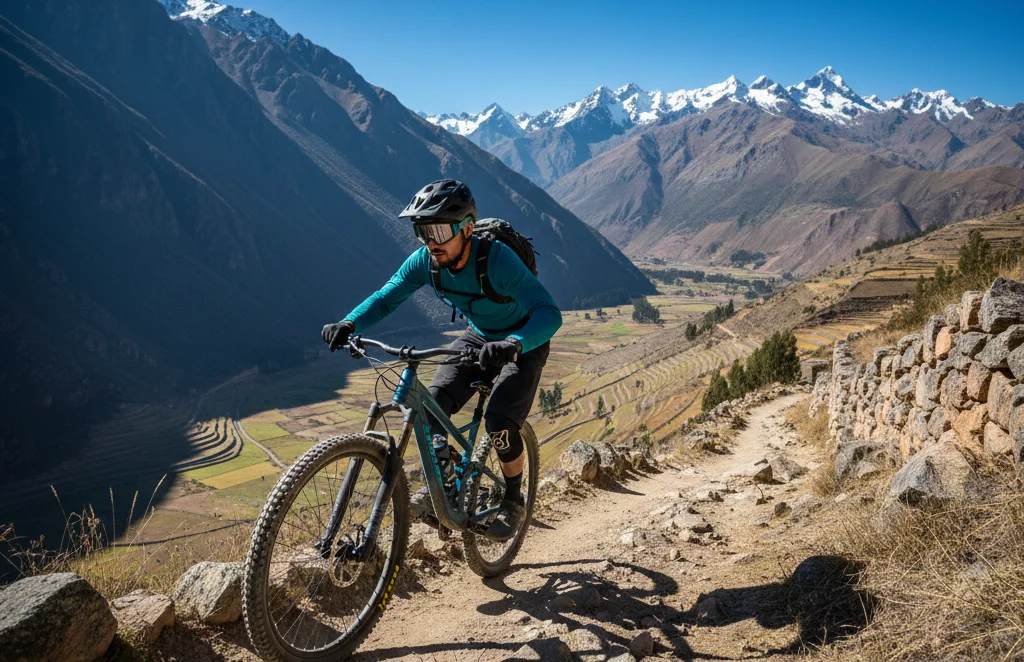
Mountain biking in the Andes
E-Bike: discover without suffering
- E-Bike to Pisac Lagoons: Kinsacocha, Azulcocha, and Pomacocha
- E-Bike through Andean Lagoons: Piuray, Chinchero, and Huaypo
- E-Bike City Tour in Cusco: Culture, Landscapes, and Andean Adventure
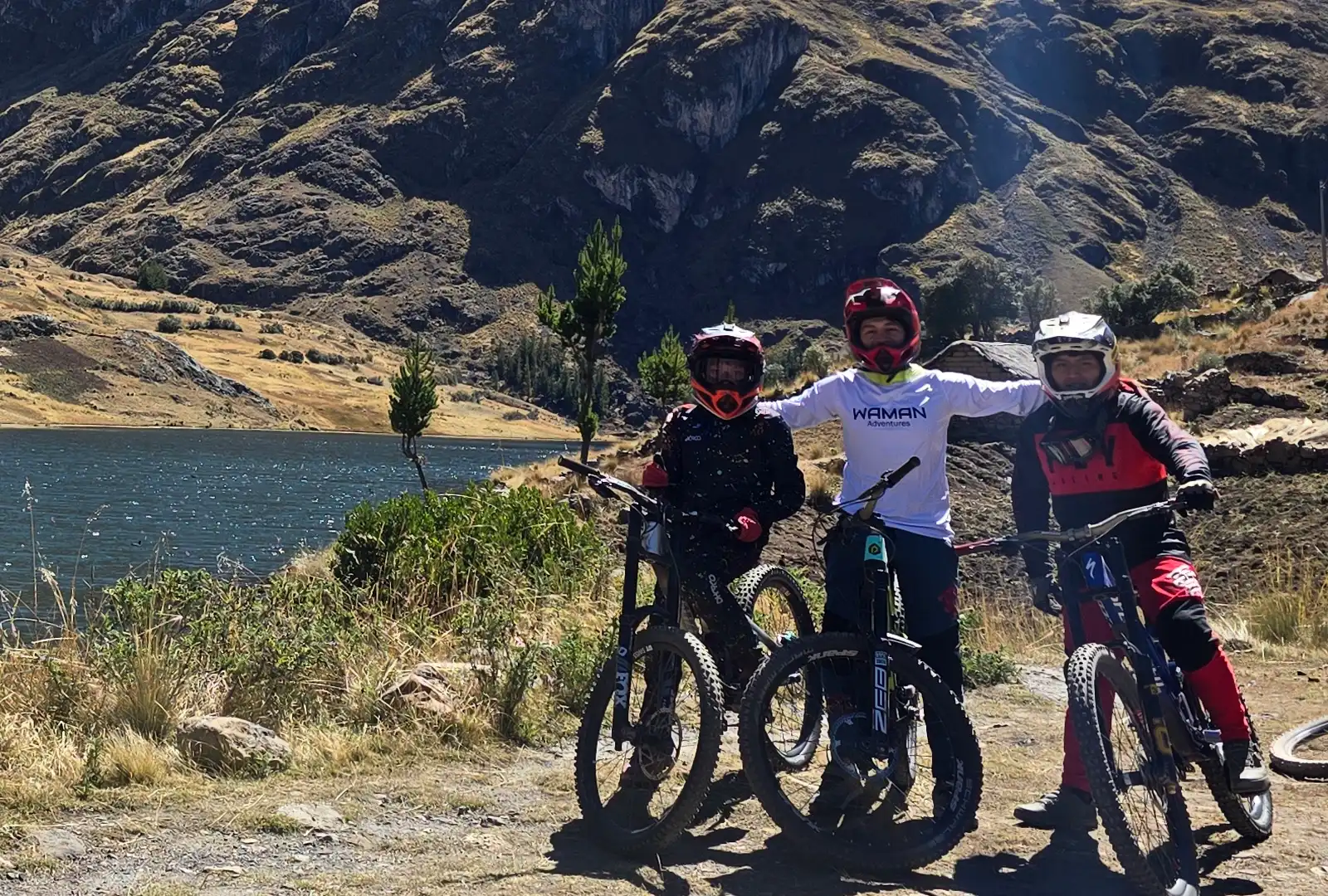
Three riders, one lagoon, Cusco breaks feel like a reward.
E-Bikes allow you to adjust assistance level according to fatigue and altitude.
Best Season for Each Modality
| Season | General conditions | Downhill | Enduro | E-Bike |
| Dry Season (April–October) | The best option: firm trails and stable weather. Daytime temperatures: 59–68°F (15–20°C). |
Compacted dirt roads in excellent conditions. Less mud = greater speed and control |
Climbs under intense sun can be demanding, but dry terrain improves technical precision. Carry minimum 101 oz (3 L) of water for long routes. |
Ideal for cultural exploration: stable weather for planning combined tours. Batteries perform better with moderate temperatures. |
| Rainy Season (November–March) | Greener landscapes, but with mud risk, abrupt changes, and possible cancellations. | Mud makes descents slower and more technical. Requires more skill to read terrain and modulate brakes. |
Recommended only for experienced cyclists comfortable in variable conditions. Difficulty can increase 30–40% depending on terrain condition. |
Most practical option in wet season: adjust routes according to weather and assistance compensates for heavy terrain. Verify the operator has E-Bikes with water protection. |
Thousands of travelers have trusted Peru Biking Tours to live unforgettable experiences in the Andes.
Your safety first
Routes adapted to your level, expert local guides and full support at all times.
Without worrying about anything
We take care of all the logistics so you can just focus on enjoying the scenery.
Authentic routes in Cusco
Experience the Sacred Valley in a real way, at your own pace, with access to the best trails.
Quality equipment
High-end enduro bikes, helmets and protective gear for all levels.
Plan your MTB experience in Cusco
MTB Day Tours in Cusco
If you want to explore MTB routes with the right logistics, local support, and suitable trail selection, check out our MTB Day Tours in Cusco.
E-bikes Tours
Curious how altitude impacts your e-bike in Cusco? Our E-Bike tours are designed for riders who want authentic enduro adventures in the Andes.


