



Quick Answer
To ride MTB in Peru, a standard travel insurance policy is not enough. Make sure your plan explicitly lists “Mountain Biking” or “Adventure Sports”, covers accidents above 9,843 feet (3,000 meters), and provides at least $100,000 in medical coverage. Without these terms, you could be left unprotected after crashes in remote terrain or technical riding.
Planning an MTB in Peru adventure above 9,843 ft (3,000 m) calls for specialized insurance that covers high altitude rescue and extraction, so you need to know how to choose the right coverage for whatever comes up, especially if you are also sorting out where to stay on the Choquequirao trek.
Planning to ride Peru’s epic MTB trails? Our Cusco day tours are built for riders seeking authentic enduro adventures in the Andes always safer and more enjoyable with the right travel insurance coverage.
Why MTB in the Andes requires special insurance
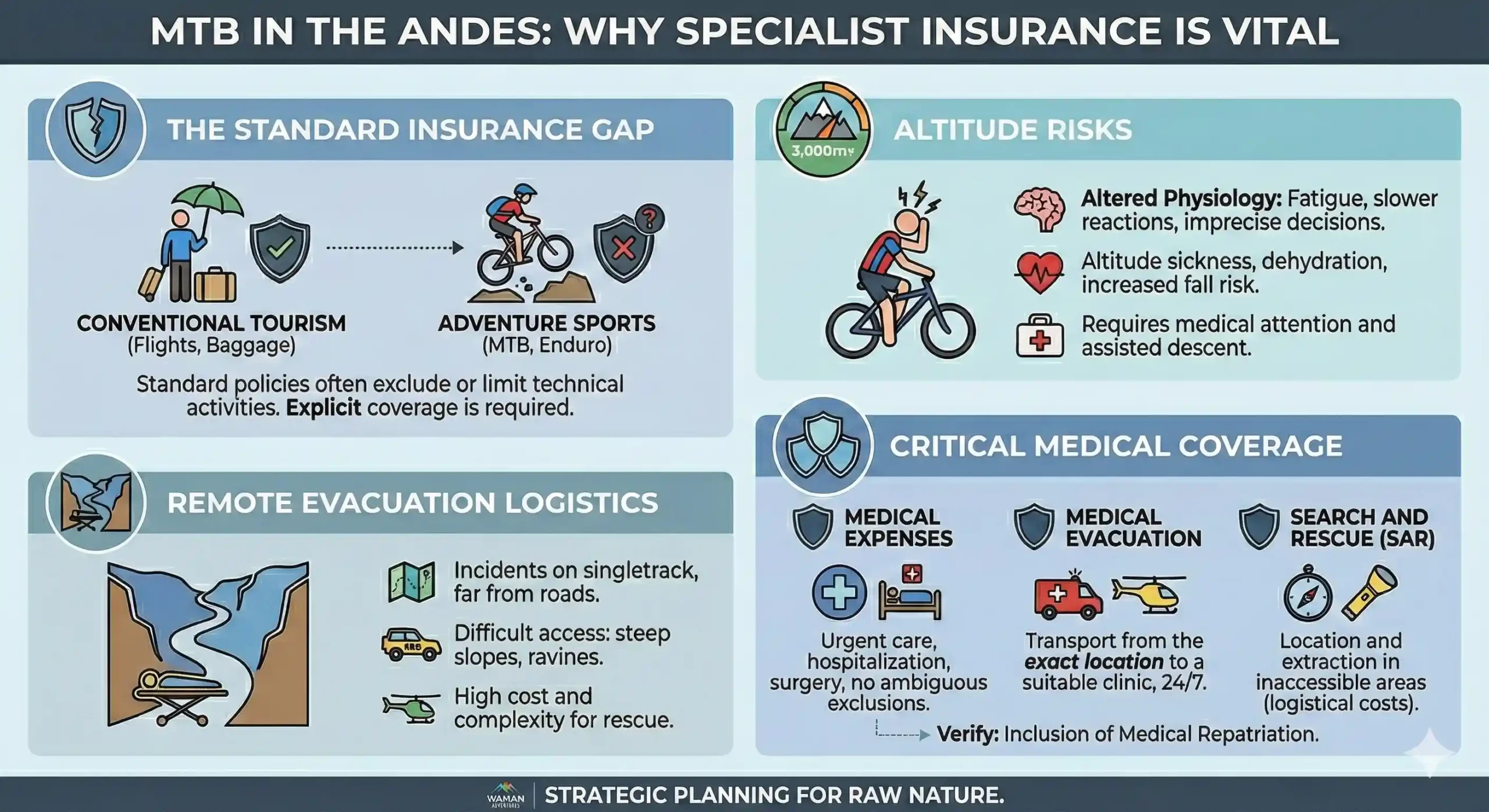
Altitude Risks and Special Insurance Coverage for MTB in Peru
The standard travel insurance coverage gap
Many conventional policies exclude disciplines like enduro or downhill, which can leave riders exposed. That is why your MTB in Peru coverage needs to spell out adventure sports instead of relying on vague, generic terms that may not go far enough.
Altitude risks above 9,843 ft (3,000 m)
Riding above 9,843 ft (3,000 m) affects your physical performance and reaction time, which increases the risk of a crash. That makes it essential to have insurance that covers medical care for soroche (altitude sickness) and an assisted descent without treating it as reckless behavior.
Evacuation logistics in remote terrain
Because accidents in hard to reach areas can require a complicated extraction, you need a policy that covers search, rescue, and emergency medical transport across demanding Andean geography.
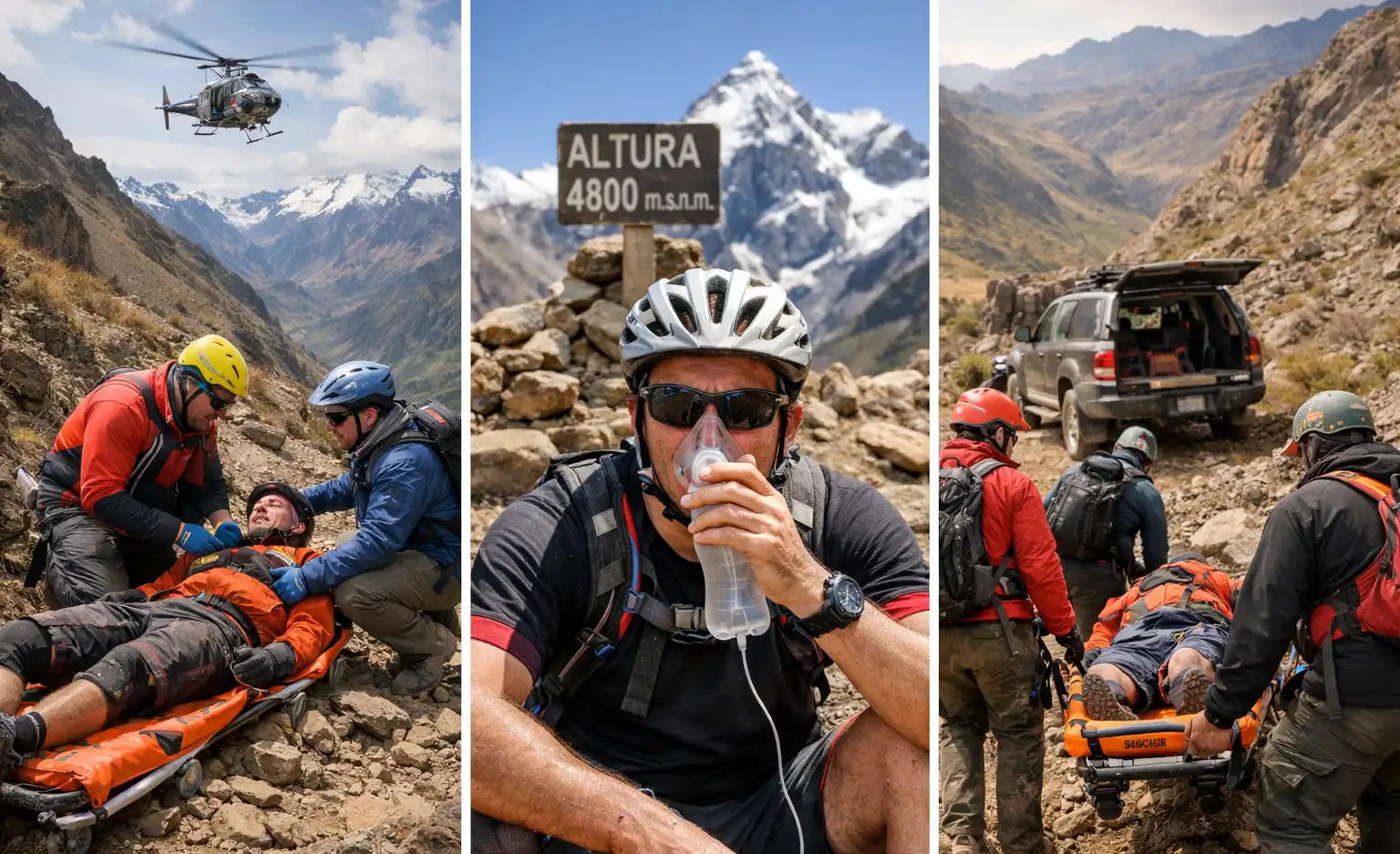
Photographic triptych showing an MTB rescue operation in the Peruvian Andes.
Critical medical coverage for riders
For a rider in the Andes, it is not enough to have a policy that lists medical expenses in generic terms. It needs to cover the real consequences of cycling in remote terrain, especially if your trip is MTB in Peru.
| Coverage Type | What it includes | Key points to verify |
| Adventure sports medical expenses | Pays for everything from stitches to surgery and hospitalization, making sure activities like mountain biking or enduro are not excluded |
|
| Air and ground medical evacuation | Covers transport from the trail to a clinic by ambulance or essential air support, which is critical for your MTB in Peru trip |
|
| Search and rescue (SAR) | Covers locating you and handling extraction logistics in places vehicles cannot reach, like remote singletracks |
|
| Medical transfer and repatriation | Ensures transfer to higher level facilities or a medically supervised return home if your condition prevents a commercial flight |
|
Definitions that can void your policy
When you buy insurance for mountain biking, you need to identify specific details that could void your policy even if the activity is included, helping you avoid coverage roadblocks.
Differences between “Cycling”, “Mountain Biking” and “Downhill”
Insurers often classify Cycling for pavement, Mountain Biking for uneven terrain, and Downhill as high risk, so your policy must explicitly list “Mountain Biking” and should not exclude “Gravity Riding” if you plan aggressive descents.

Visual Differences Between Road Cycling, MTB, and Downhill for Insurance Purposes
Maximum altitude restrictions
Because many Andean routes climb above 9,843 ft (3,000 m), it is essential to confirm that the maximum altitude listed in the general terms fits your itinerary and applies to adventure sports.
Exclusions for unauthorized areas or off route
Terms like “off route” can complicate a claim if you take improvised shortcuts, so it is smart to ride with a local guide whose testimony can support your documentation with the insurer, showing the accident happened on a reasonable route.
Warning:
In many policies, the insurer can deny payment if alcohol or substances show up in your bloodwork, classifying it as “reckless behavior.”
Gear protection and travel logistics
Your policy for mountain biking in Peru should protect both your health and your investment in gear, while also covering the financial logistics of unexpected mechanical issues.
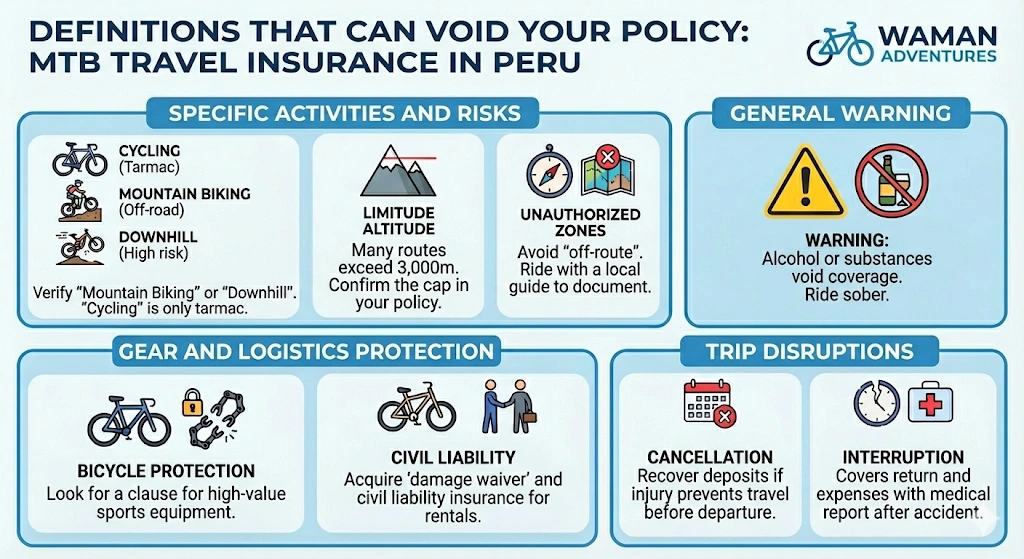
Key Definitions and Exclusions in MTB Travel Insurance for Peru
Theft or accidental damage to your own bike
Confirm that your insurance covers high value sports equipment, including transport damage and theft with forced entry, and always review depreciation rules and invoice requirements.
Expert tip:
Confirm whether original invoices are required, and remember that unattended theft is often excluded
Coverage for rental bikes and liability
Liability coverage is essential to cover damage to third parties, or you should purchase the operator’s local insurance in Cusco if your main policy does not cover rental bikes.
Trip cancellation and interruption
Cancellation coverage protects your investment in case of injuries before your trip, while interruption coverage typically requires a local medical report to fund an early return and cover logistics costs if an accident stops your route.
Checklist: Before you pay for your policy
| Activity verification | Recommended coverage | Clinic network in Cusco |
|
|
|
Plan your MTB experience in Cusco
MTB Day Tours in Cusco
If you want to explore MTB routes with the right logistics, local support, and suitable trail selection, check out our MTB Day Tours in Cusco.
Multi-Day MTB Tours
For more comprehensive experiences that connect several valleys and high mountain routes, discover our multi-day MTB Tours.


