


Quick Answer
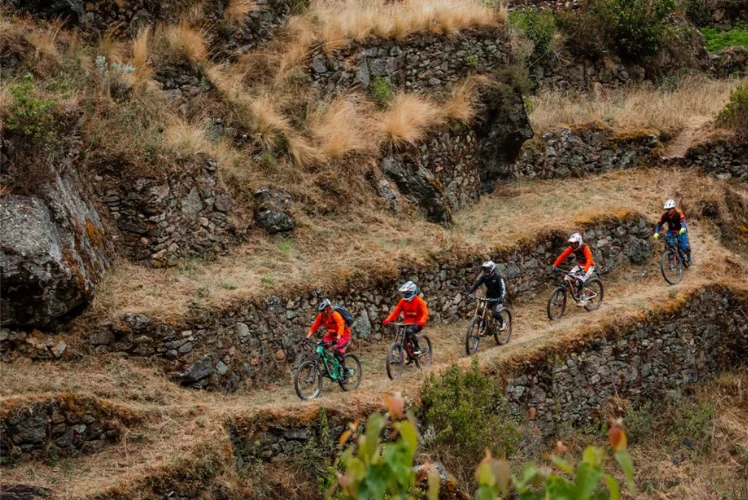
The heart of the Inca Avalanche is the sheer intensity of the Mass Start at around 14,160 ft (4,316 m). Your first priority is simply to fight for position inside a fast moving pack as it drops at full speed across the wide open section before the course pinches down.
This format demands lightning fast trail reading and real composure. You have to spot gaps, protect your momentum through dust and shoulder to shoulder friction, and hit the singletrack in a strong spot. That bottleneck is the make or break moment where the trail width disappears and passing chances get scarce.
The Inca Avalanche Cusco, marketed in recent editions as Inka Avalanche or Inka Avalanche Wayki Fest, is a brutal endurance test that links the high altitude slopes of Abra Málaga to the Sacred Valley, cutting through shifting ecological zones that change traction and technique from one segment to the next. Along the way, you have to manage your energy to handle hard pedaling stretches and natural rock gardens without losing flow. Your bike takes a beating from start to finish, and the final minutes come down to traction on warmer terrain that can get damp in spots, just as fatigue peaks.
What is the Inca Avalanche Cusco like?
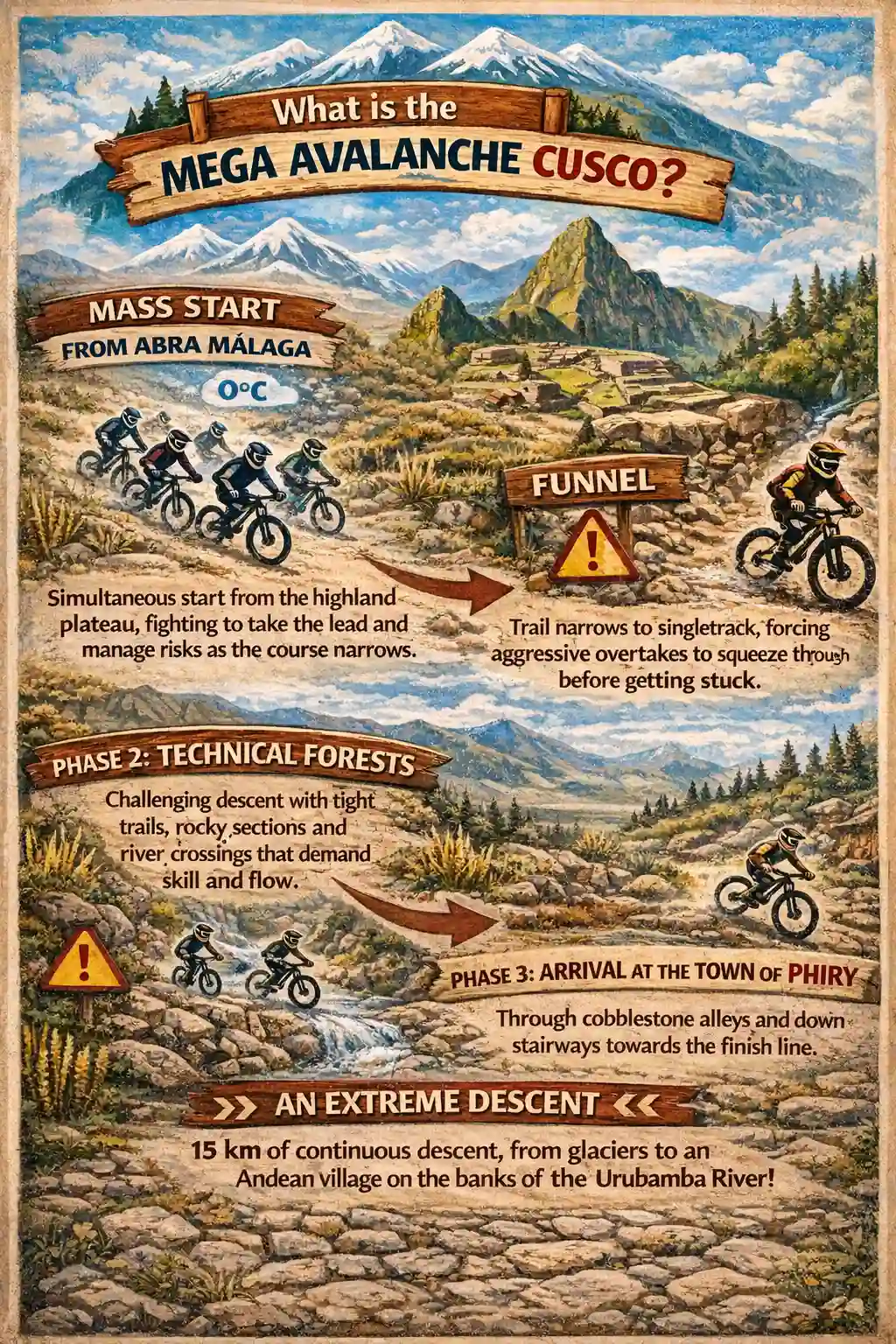
The Inka Avalanche course is a sharp shift between ecosystems and race pace, forcing you to reset your mindset across three distinct stages.
PHASE 1: Mass Start in the high Andes
A mass start from Abra Málaga on a wide, fast track. Your goal is to sprint and gain position on the grid before the road narrows, to cut the risk of crashes in the pack.
PHASE 2: The funnel and technical singletrack
The track tightens dramatically at the funnel, creating traffic if you do not hit it near the front. The terrain switches to a technical trail of dirt and loose rock, demanding flow and physical effort in pedaling sections.
PHASE 3: Transition into the valley and an urban finish
The weather turns warmer, and the trail can get damp and rooty. The route finishes by cutting through town (Phiry or T’ancaq) via stair sets and alleyways in an Urban DH style, ending beside the Urubamba River.
Infographic: What is the Inca Avalanche Cusco like?
How do you enter the race?
To race the Inca Avalanche Cusco, you need to prepare physically, mentally, and logistically for one of the most demanding downhill events in the country. Here is what you need to know about how it works and what organizers typically require.
Race Schedule
| Day | Main activity | Important detail (closures) |
| Friday | Official practice, ceremony, and bib pickup (afternoon). | Course recon and administrative check in. |
| Saturday | Qualifiers, timed runs to set your start position. | Traffic is restricted during scheduled time windows between Abra Málaga and the valley to support the event. |
| Sunday | The final: mass start, with winners decided by finishing order. | The route closes completely during the race. |
Dates, Weather, and Costs
| Detail | Information |
| Season | Dry season (May to October). Check the exact date each year before you travel. |
| Weather | Start around 32°F (0°C) and finish in the valley at up to 77°F (25°C). |
| Registration (estimated) | • Presale: $26 (S/ 100) • Regular: $39 (S/ 150) • Late: $53 (S/ 200) |
| What is included? | Transport to the start, breakfast and lunch, plate, bib, sticker, and safety coordination. |
Categories, Gear, and Rules
| Item | Details |
| Categories | Elite/Pro, Amateur/Open, Masters (30, 40, 50+), and Women. |
| The “Hardtail” | Hardtail category: descending Abra Málaga without rear suspension. |
| Required gear | 1. Full face helmet. 2. Knee pads and elbow pads. 3. Goggles for dust or rock strikes. |
| Recommended | Chest protector, gloves, and a neck brace. Check the rules on GoPro use; it is sometimes prohibited. |
| Key rules | • No alcohol or drugs. • No littering. • Follow course markings. • Sign a waiver. |
| Prizes | Elite: Cash. Amateurs: Sponsor products (tires, accessories, etc.). |
Transport logistics
Getting to Abra Málaga takes smart timing on a mountain road. Plan for about 2 to 3.5 hours from Cusco or about 1 hour from Ollantaytambo, always leaving a cushion for surprises so you do not lose your spot on the start grid.

Participants secure their mountain bikes on a vehicle for the shuttle up to the high-altitude starting point.
Which is the better choice, pure DH or Enduro?
In the Inca Avalanche, you do not choose your bike based on how it feels on the best section, but on how it behaves on the worst one. The course is long, with very fast zones, but it also has flats and short climbs that, above 13,123 ft (4,000 m) at the start, will destroy your legs if you bring the wrong bike.
| Feature | Downhill bike (DH) | Enduro bike |
| Suspension | 200 mm. Soaks up everything. It forgives big mistakes and can save you if you come in too hot to a rock garden. | Up to 160 mm. More agile and efficient to move around, with the tradeoff of sending more vibration into your body. |
| In pedaling sections | A drag. Hard to accelerate on flats and slower to sprint off the line. | Efficient. Transfers power to the ground better, ideal for saving time on connectors and short climbs. |
| Managing pack traffic | Stable but clumsy. Harder to change lines quickly in tight spaces. | Agile and responsive. Great for sharp moves, passes, and quick line changes. |
| Physical factor | Less arm fatigue. The bike does more of the dirty work and beats up your body less. | More wear. By the end of the descent, arms and hands take more punishment due to the stiffer feel. |
| Who is it for? | For riders who prioritize safety and raw speed in the roughest, most technical sections. | For riders who want versatility and to gain positions by pedaling where DH bikes bog down. |
Pro tip:
An enduro bike speeds up the pedaling, but your tires are the priority. Run reinforced casings (DH style) and add inserts to protect your rims on loose rock.
Prep before race day
Fitness
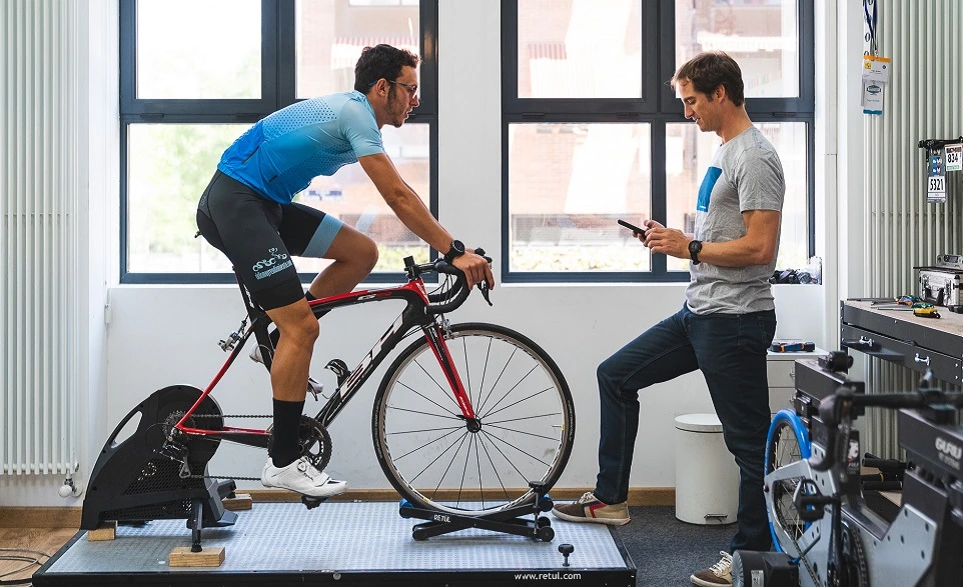
For this race, bike park explosiveness does not mean much if you do not have endurance. Your training should focus on upper body and core muscular endurance. Look for long trails where you can descend for 15 to 20 minutes straight without stopping; that teaches your arms to work through lactic acid buildup and delays arm pump.
Biomechanical assessment and physical conditioning for cyclists
Technical maintenance and bike tuning
Mechanical
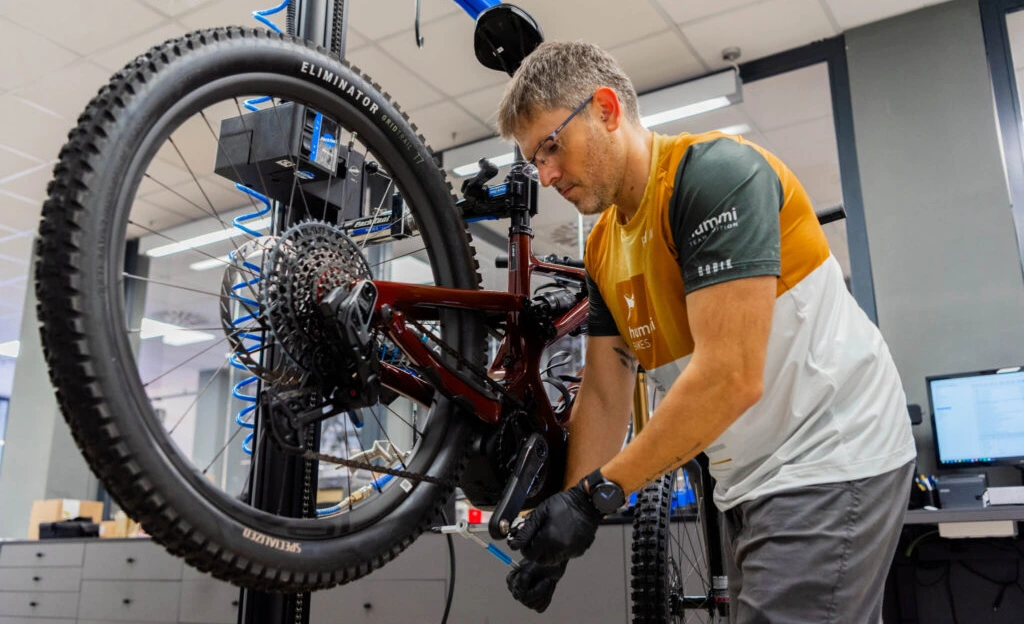
Here, you need to armor up your bike. Start with the wheels: install tires with a reinforced casing and make sure your tubeless sealant is fresh. For brakes, if you run 180 mm (7.1 in) rotors, consider stepping up to 200 mm (7.9 in) or 203 mm (8.0 in). Finally, do a full check with a torque wrench on every bolt in your suspension and rear linkage; the constant vibration on this route loosens hardware that would never move on other tracks.
Taking on this descent is a rite of passage that forces you to empty the tank and stay fully focused, whether you are chasing a podium or just trying to reach the finish on raw, constantly changing terrain. If racing still feels intimidating, riding the route first in tour mode is the smartest strategy to study lines without the clock pressure and build confidence; but if you are ready, secure your registration and get set for one of the most intense MTB experiences in Cusco.
If you are planning your trip for the competition or want to do a pre ride of the route, Peru Biking Tours can handle all your logistics so you only worry about riding; reach us at +51 946 459 491 and we will set up your adventure.


