


Quick Answer:
Riding in Urubamba allows you to explore the most spectacular corners of the Sacred Valley with trail options for various skill levels. Discover the most iconic circuits, the best bike gear to bring, and how to plan your perfect mountain biking adventure.
Your trip through the Sacred Valley can be one of your best, especially as you pass through Pisac and Ollantaytambo at a friendlier altitude than Cusco. Keep in mind that you are not riding in a built “park” made for cyclists here. You are riding through a living landscape, with culture, agriculture, and communities that still use these roads every day. In this guide, you will find the essentials for choosing MTB routes in Urubamba based on your level, handling altitude intelligently, planning the best season to ride, and moving safely without losing the cultural focus of your itinerary.
Want to ride one of the most technical descents in the Sacred Valley? Explore our Day Tours in Cusco designed for riders looking for real enduro in the Andes.
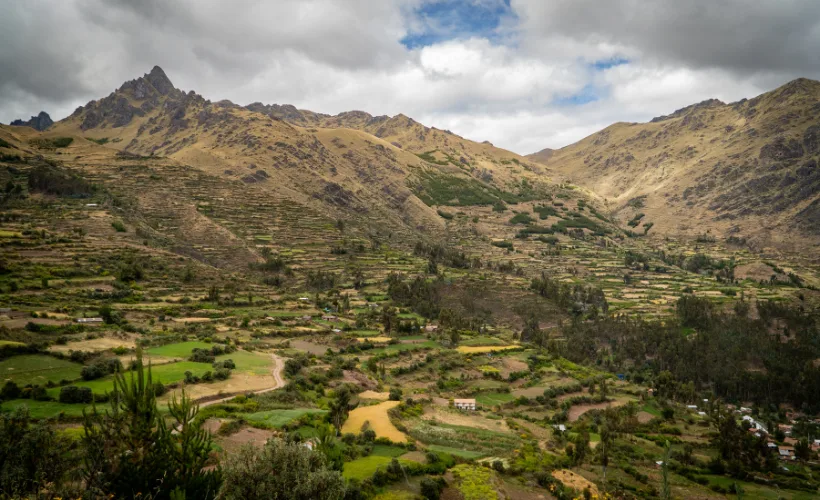
Where Urubamba is and why it is perfect for MTB
Urubamba sits at around 8,858 to 9,514 feet (2,700 to 2,900 meters), which makes it slightly lower than Cusco. For you, that is an advantage if you are arriving from home, because it helps you acclimate gradually before taking on more demanding high altitude rides.
Urubamba is a strategic place to explore MTB for several geographic and cultural reasons, such as these:
Ancestral and rural roads that are perfect for MTB
From wide community roads to trails used by local communities and livestock, the network of natural routes lets you build varied itineraries with different levels of difficulty. Many of these roads have existed for centuries, and today they are used by both locals and riders.
Mild weather and diverse scenery near Urubamba
Unlike Cusco, where mornings can feel colder and foggier, Urubamba and its surroundings usually have a milder climate. During the dry season, that usually means more sunshine, better visibility, and, in general, better traction for riding.
A strategic location in the Sacred Valley
The Sacred Valley works as a geographic corridor stretching from Pisac to Ollantaytambo, and Urubamba sits right in the middle. That makes it an ideal base for creating loop rides or descents toward communities such as Maras, Moray, or Calca.
The perfect blend of rural life and living culture
When you ride the MTB trails in Urubamba, you are not just seeing natural scenery. You also pass through orchards, cornfields, and communities where ancestral roads are still used to move products and animals. That gives the adventure a unique cultural value.

The full face helmets and technical gear show they are preparing for a demanding route.
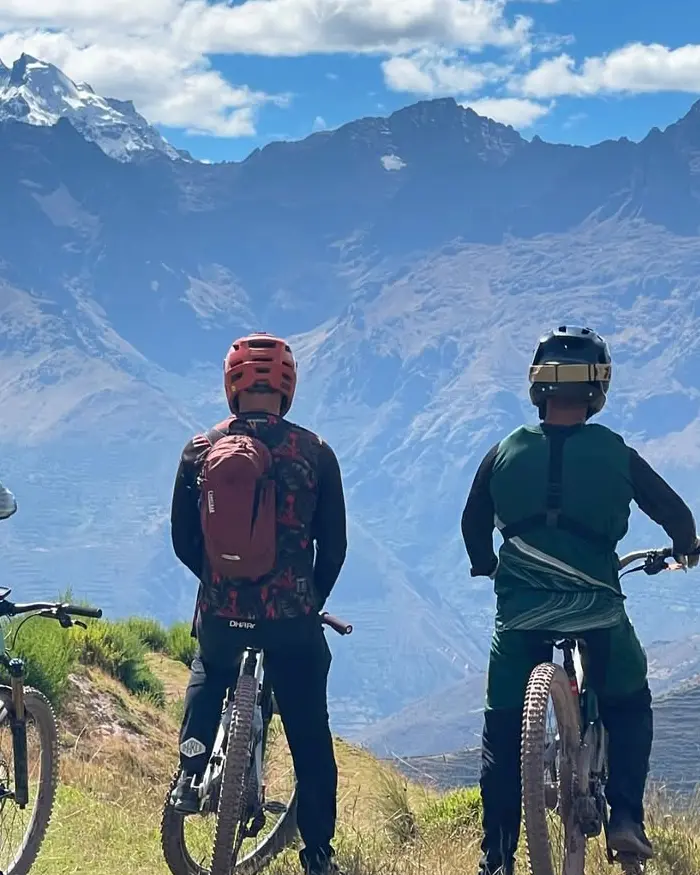
The scene conveys calm before starting a technical descent on mountain trails.
What kind of MTB terrain you will find in Urubamba
The ground changes a lot within just a few yards. On a single descent, you can move through firm sections and then suddenly enter loose terrain. The most common surfaces include:
- Hard packed dirt: it feels fast and stable, but it can become slippery if there is fine dust or moisture.
- Fine gravel: it reduces traction in corners and under braking, so it demands smooth brake control and good balance.
- Embedded stone: it creates vibration and forces you to choose your line well so you do not lose speed or control.
- Loose rock: this is the most unpredictable part. The bike tends to float, and it asks you to look ahead and keep light hands.
- Shared community roads: you are not riding alone. There may be pedestrians, animals, or local traffic, so it is important to manage your speed wisely.
Warning:
Do not enter “marked” trails made by footprints if they cross fields or run along private land.
Main types of MTB routes in Urubamba
Wide rural roads (beginner to intermediate level)
- Hard packed dirt with stretches of fine gravel
- Gentle or moderate slopes
- Wide turns and good visibility
- Occasional traffic from locals or rural vehicles
Hillside descents into the Sacred Valley (intermediate level)
- Narrower trails
- Sections with loose gravel and small stone
- Moderate to steep slopes
- Tight switchback corners
- Fast surface changes
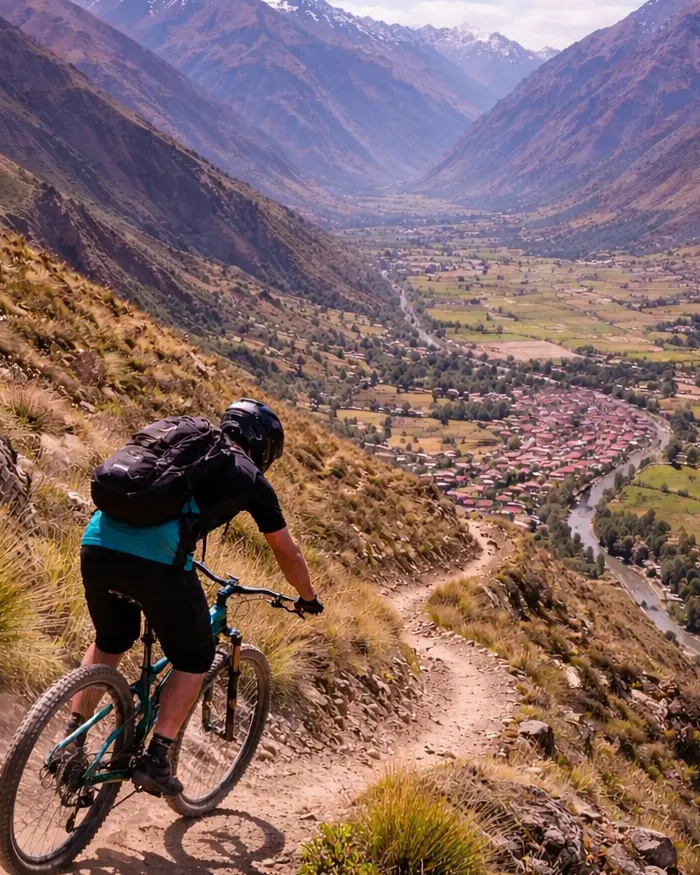
In Urubamba, you will find long descents where brake control and balance matter more than speed.

The cyclist wears a helmet, backpack, and technical clothing, ready for a long and demanding descent.
Technical routes with rock and mixed terrain (intermediate to advanced level)
- Natural stone steps
- Sections with loose over hard rock
- Irregular embedded stone
- Constant transitions between firm dirt and broken sections
- Rain channels formed by runoff
Long connections between communities
These routes are longer and require more physical endurance. Some connect Urubamba with areas such as Huayllabamba or nearby communities, and they usually feel more demanding because of the total ride time.
What kind of rider are these routes ideal for?
These routes are ideal for you if you are looking for longer rides with a mix of climbing and descending. You will find wide rural stretches mixed with technical sections, along with greater cardiovascular demand because of the altitude.
Warning:
Do not underestimate dehydration in the valley just because it does not feel as cold as Cusco.
How altitude affects your MTB experience
| Area | What changes at altitude | Typical signs while riding MTB |
| Breathing | Less oxygen available with each breath | You feel short of breath on easy climbs, breathing becomes rapid |
| Heart rate | Your pulse rises to compensate | Your heart rate spikes earlier than normal, especially on short climbs |
| Fatigue | Aerobic capacity drops | Your legs feel heavy sooner, and you empty out faster |
| Recovery | You recover more slowly after hard efforts | It is harder to bounce back after a steep climb |
| Concentration | Hypoxia plus fatigue reduce focus | Simple mistakes: braking late, poor line choice, clumsy cornering |
| Hydration | You lose more water through breathing and the dry environment | Dry mouth, headache, early fatigue |
💡 Pro Tip — Do not underestimate hydration here
The Sacred Valley is warmer and milder than Cusco, which makes many travelers drink less water because they do not feel as cold. But at altitude, your body loses more fluid because of faster breathing and the dry environment. Drink water before you feel thirsty. Once you feel thirsty, you are already mildly dehydrated. Aim for at least 1.5 to 2 liters during the day, plus electrolytes on longer routes.
Best time of year to ride in Urubamba
| Key Factor | Dry Season (April – October) | Rainy Season (November – March) |
| Rainfall | Very low | Mostly clear days. |
| Trail condition | Firm, compact ground with better natural drainage. | Soft or muddy ground, with a risk of slippery sections. |
| Traction and control | Excellent traction on hard packed dirt and dry stone. | Variable traction; gravel and mud can become unpredictable |
| Descent safety | More stability in corners and under braking. | More caution needed in corners because of mud or wet rock. |
| Scenery | Drier tones and more defined mountains beneath an intense blue sky. | Greener, more vibrant landscapes with lush vegetation. |
| Daytime temperature | 64–72 °F (18–22 °C) approx. | 62–70 °F (17–21 °C) approx. |
| Tourist traffic | High from June to August | Lower, except around the end of the year. |
| Service prices | Higher in peak season (June to August). | Generally more affordable. |
| Recommended MTB level | Ideal for all levels, especially beginners and intermediate riders. | More recommended for riders with experience on variable terrain. |
⚠️ November – March: what changes
Gravel can become unpredictable, rock will be slippery, and erosion channels will appear, changing the terrain from what you may have seen on downloaded tracks. The landscape is greener and more vibrant, but the experience is more suitable for riders with experience on variable terrain. For beginners and intermediate riders, the dry season (April to October) is the safer and more predictable option.
What to bring for MTB in Urubamba
- Certified helmet (full face for technical routes or open face for trail/XC).
- Gloves with good grip and palm protection.
- Glasses with UV400 protection and good dust coverage.
- MTB specific shoes with a stiff sole and solid traction.
- Broad spectrum SPF 50+ sunscreen.
- Hydration system (at least 1.5 to 2 liters, more on long routes).
- Light, packable windbreaker jacket.
- Basic repair kit (multi tool, tube or tubeless kit, pump or CO₂, quick link).
- Energy snacks or bars to keep your energy level up.
Real safety considerations on Urubamba routes
Routes with active community use
Many roads in the Sacred Valley are not exclusive recreational trails. They are part of the rural network that connects communities, farms, and agricultural areas. That means you may encounter occasional foot traffic, motorcycles, or local vehicles, especially near village access points.
Frequent presence of loose livestock
It is common to come across cows, sheep, or donkeys in high areas and on open roads. Because livestock can move unpredictably, it is best to slow down early and avoid sudden maneuvers.
Lack of formal technical signage
You will not find bike park style trail signage such as green, blue, or black ratings. To navigate, you will depend on local references, GPS tracks, or previous knowledge of the terrain. At rural forks, it is normal for there to be no clear signs.
Sections with moderate side exposure
On some hillside routes, you will see edges that drop toward agricultural terraces or natural slopes. They are not always extreme, but they will require good line choice and control, especially when the terrain is loose.
Variable surface after rain
Even though the weather is stable for much of the year, rain can carve channels, cause erosion, or move gravel around. Because of that, the ground can change and may not look the same as it does on old maps or tracks.
Inconsistent cell coverage
In high zones or between mountains, phone service can be limited or intermittent. That reduces your ability to communicate immediately if something goes wrong.
Distance from medical services
There is no immediate care in rural sectors. The closest help is usually in Urubamba or in larger towns in the Sacred Valley, so response times may be longer.

Irregular cell coverage becomes more noticeable when you enter narrow roads winding between hills.
The cultural and scenic setting of the Sacred Valley
- One of the biggest differences with MTB routes in Urubamba is the cultural context.
- During the ride, you may see:
- Active agricultural terraces.
- Quechua communities.
- Traditional architecture.
- Corn and potato fields.
- Open views of snow capped Andean peaks.
- This is a living landscape, not a recreational park.
- Important: You should not ride inside protected archaeological zones.
How to combine MTB with your trip to Machu Picchu
Take advantage of nearby train connections
Most trains to Machu Picchu operated by PeruRail and Inca Rail leave from Ollantaytambo.
Urubamba is about 30 to 40 minutes away by road, which lets you stay in the valley, ride MTB in the morning, and catch a train in the afternoon or the next day.
Optimize transfer times
The Sacred Valley sits at a lower altitude than Cusco, which makes it easier to rest before visiting Machu Picchu. You can schedule a half day MTB outing and then continue to Ollantaytambo without returning to Cusco.
Include archaeological sites without major detours
From Urubamba, you can visit sites such as Ollantaytambo or nearby areas without disrupting the overall flow of the trip. That lets you combine physical activity in the morning with cultural heritage in the afternoon.
Explore markets and living culture within the same geographic area
The Sacred Valley is home to traditional markets and Andean towns where you can add cultural experiences without long transfers.
Add short hikes before or after MTB
The valley has short hikes that you can add to your day without complicating your logistics to Machu Picchu.
The Sacred Valley lets you enjoy many MTB routes in Urubamba for different levels. Choose the right season and ride thoughtfully on shared roads, and you will enjoy more with less risk. On top of that, it fits perfectly into your plan toward Machu Picchu. If you want everything to be well planned, safe, and adapted to your level, Peru Biking Tours is your best ally. We can guide you with the ideal route, the logistics, and the right gear. Contact us at +51 946 459 491 and start planning your next bike adventure.
Thousands of travelers have trusted Peru Biking Tours to enjoy unforgettable experiences in the Andes.
Your safety comes first
Routes adapted to your level, expert local guides, and full support at every stage.
No worries at all
We take care of all the logistics so you can focus on enjoying the scenery.
Authentic routes in Cusco
Experience the Sacred Valley in a real way, at your own pace, with access to the best trails.
High quality gear
High end enduro bikes, helmets, and protective gear for all levels.
Plan your MTB experience in Cusco
MTB Day Tours in Cusco
If you want to ride routes like Lamay Sapacto with the right logistics, local support, and the right trail selection, check out our MTB Day Tours in Cusco.
Multi-Day MTB Tours
For more complete experiences that connect multiple valleys and high mountain routes, explore our Multi-Day MTB Tours.


