


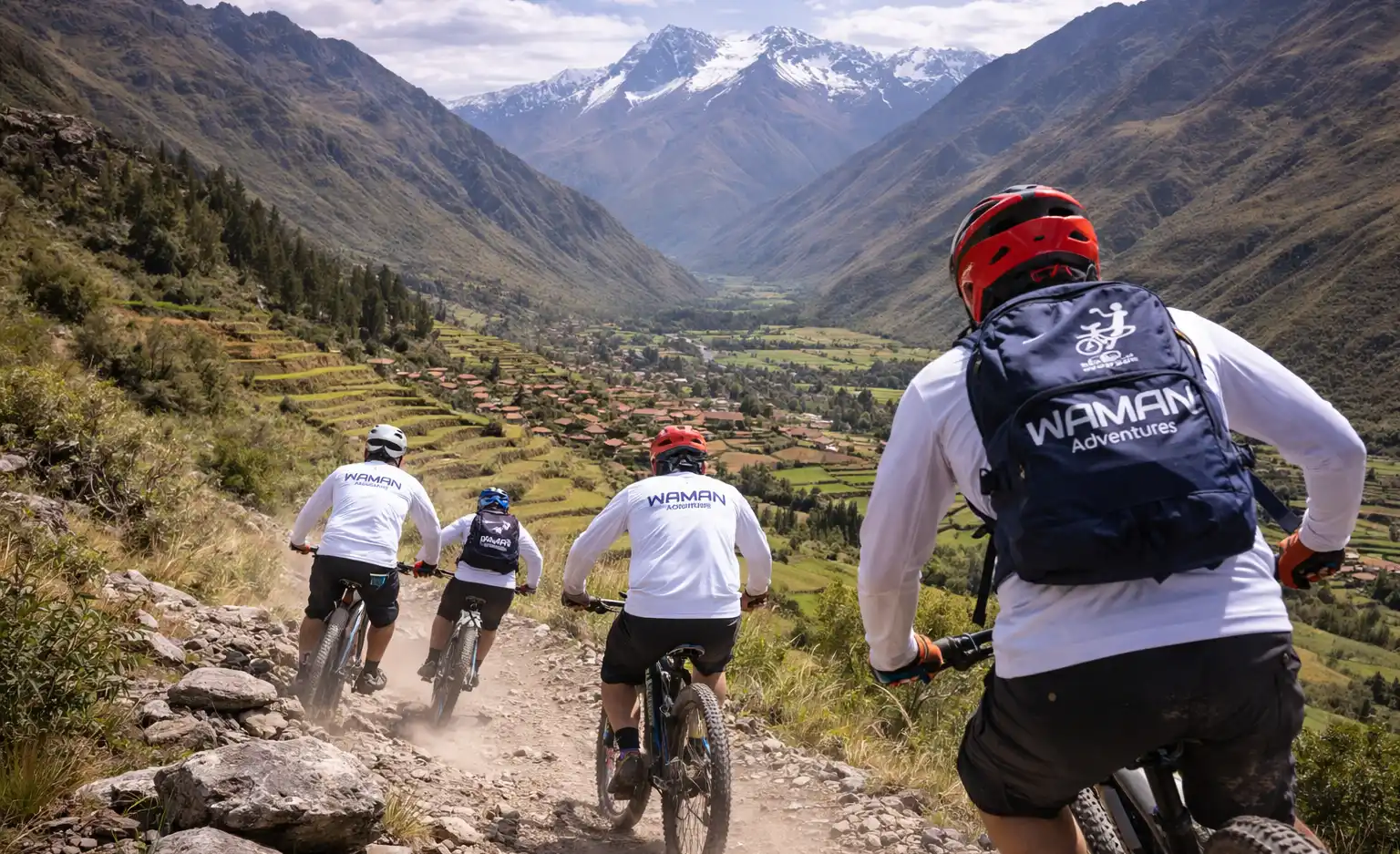
Quick Answer
Many riders arrive to tackle MTB in Cusco overconfident in their skills from back home. Here, an intermediate trail demands twice the effort—and not because of the size of the jumps, but because oxygen is scarce at 11,155 feet (3,400 meters). You do not need to be a pro to truly enjoy the ride, but you certainly need “legs” and refined braking technique. The secret here is not top speed, but having the endurance to maintain control and proper form on long descents.
Altitude and technical terrain make MTB in Cusco feel tougher than most riders expect. This quick test helps you choose the right route so you can enjoy the experience and avoid unnecessary risk.
Wondering what your MTB skill level really is in Cusco? Our day tours are designed for riders who want authentic enduro adventures in the Andes—always smoother when you match your skills to the right route and use a rider guide to test your level.
The reality of MTB in Cusco
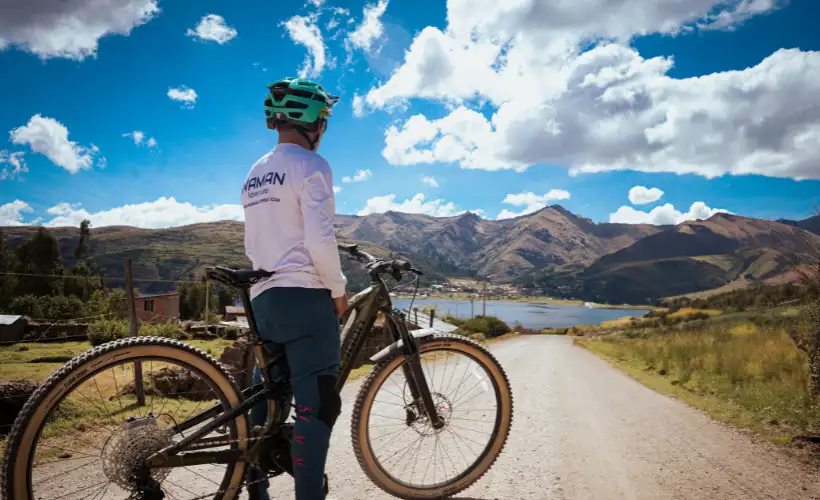
The start point near Laguna Sapacto sets the tone, high altitude air, wide views, and a long descent ahead.
The oxygen factor
At 11,152 ft (3,399 m), your body gets less oxygen, your heart rate climbs faster, and fatigue hits much sooner. On the trail, that can make you brake late when you are tired or lose precision in corners when your legs feel heavy. Once you understand this, you will ride with the right mindset. An Andean mountain biking route demands more fitness than a ride at sea level, so you need to prioritize clean technique over pure speed while you adapt.
The terrain: rock steps, baby heads, and exposure
Here you ride on natural Andean terrain and old roads littered with rocks, uneven steps, and constant grip changes. You will often hit rock stair sections where the bike bounces if you do not stay active, plus the famous “baby heads” (loose, rounded rocks) that push you off line the moment you tense up. Add narrow trails with serious side drop offs, and you will see why “intermediate” in Cusco is a real challenge that forces you to look ahead and stay calm when the trail gets ugly.
What kind of MTB trail are you looking for?
In the mountain biking world, speed and your margin for error change fast depending on where you point your front wheel. Choose the right discipline, and this test will feel a lot more realistic.
Singletrack vs. Wide Track
| Feature | Descending on Singletrack | Descending on a Wide Track |
| The terrain | A narrow line, tight turns, and natural obstacles you cannot simply avoid. | More space to correct your line and read what is coming with more margin to react. |
| The demand | You have to spot rocks and drainage cuts in seconds. Mentally intense because of exposure. | Fewer decisions per second, but you must manage braking and physical fatigue. |
| The typical mistake | Over braking in loose sections, staring at your front wheel, or entering a turn on the wrong line. | Getting overconfident because the track is wide, braking too late, or overheating your brakes. |
What does this mean for your riding?
- If you are coming for XC / Trail: Your ride will mix pedaling with descents on wider tracks or moderate trails. Your limiting factor will be endurance, not so much jumps or big rock features.
- If you are coming for Enduro: You will combine pedaling with long descents on technical singletrack. Your challenge is keeping consistent technique under fatigue (when your legs stop cooperating).
- If you are coming for Downhill: It is almost all steep, fast descending. Here the limit is fine control and risk management; you need full protective gear.
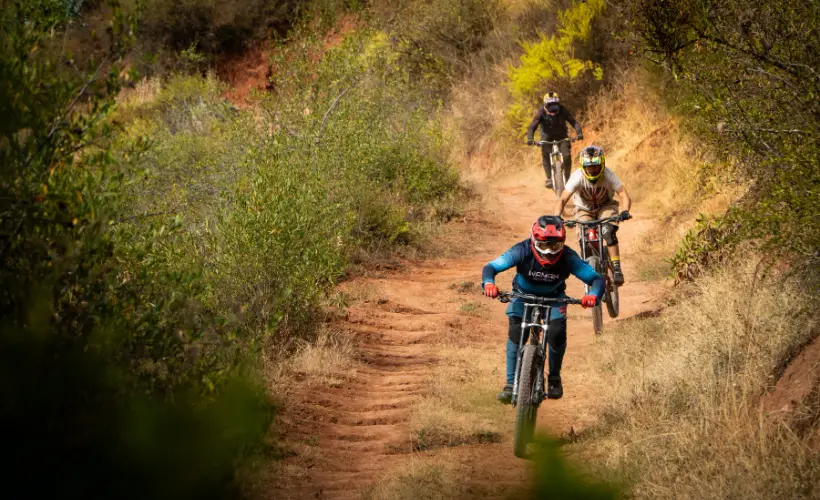
Lamay singletrack turns into a tight ribbon, and the rider train stays locked in from the first corner.
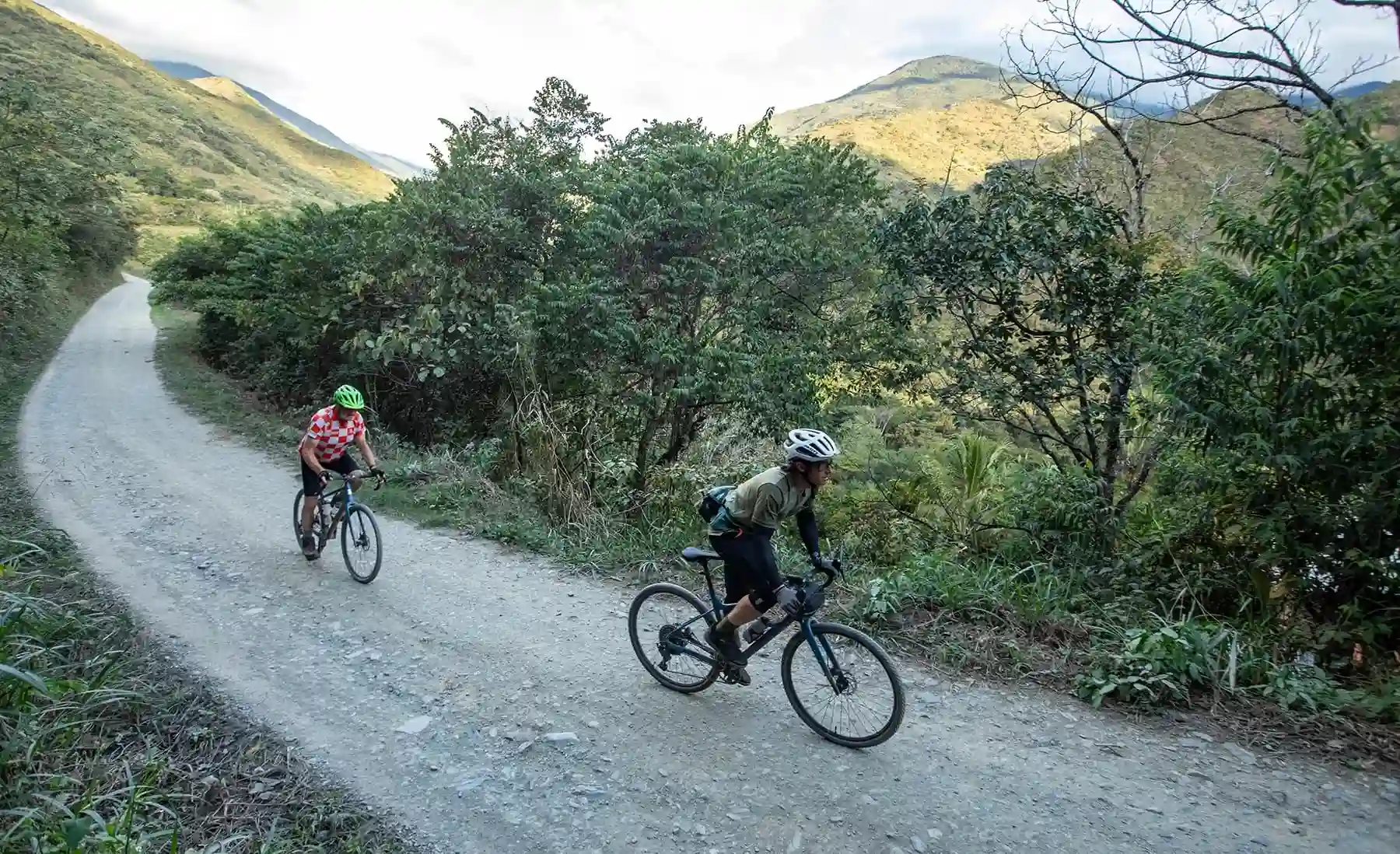
Two mountain bikers descend a wide, curving gravel road on a green hillside.
Quick Level Test for MTB in Cusco
For this to work, be honest. Read the 5 situations and choose the option that describes you best. Keep your score in mind:
- If you choose A = Add 1 point.
- If you choose B = Add 2 points.
- If you choose C = Add 3 points.
1. Braking control: does loose terrain take over?
- A (1 pt): I skid a lot or grab the brakes in panic.
- B (2 pts): I lock a wheel sometimes, but I can recover.
- C (3 pts): I brake progressively and do not skid.
💡 Local tip: In Cusco, dry ground punishes sudden braking.
2. Body position: passenger or pilot?
- A (1 pt): I descend almost always seated.
- B (2 pts): I stand for sections, but I get tired fast.
- C (3 pts): I hold an attack position consistently (elbows out, active).
💡 Local tip: Sitting on Inca stone steps is risky because the bike bounces.
3. Obstacles: do rocks slow you down?
- A (1 pt): I get off the bike often if I see rocks or broken sections.
- B (2 pts): I ride some of it, but I walk if it looks really bad.
- C (3 pts): I ride most of it with commitment by choosing a line.
4. Steepness: when the hillside tilts…
- A (1 pt): I tense up and feel like I will get launched.
- B (2 pts): I descend cautiously and rely on braking a lot.
- C (3 pts): I feel comfortable, shift my weight back, and flow.
5. Endurance: can you handle a 20 minute descent?
- A (1 pt): No, I lose strength and form fast.
- B (2 pts): I can hang on, but my technique falls apart by the end.
- C (3 pts): No problem, I keep my technique even when tired.
💡 Local tip: At 13,123 ft (4,000 m), fatigue can hit about twice as fast.
👇 YOUR RESULTS 👇
You scored 5 to 8 points: BEGINNER LEVEL
The diagnosis: You need confidence and space. Your technique is still developing, or altitude hits you hard. In Cusco, that is not a bad thing, but it means you need routes with room to correct mistakes.
👉 Your ideal routes: Maras Moray, Huaypo (wide tracks and scenery).
You scored 9 to 12 points: INTERMEDIATE LEVEL
The diagnosis: You have a strong base. You modulate your brakes and clear medium obstacles, but extreme fatigue or very rough sections can still put you in trouble.
👉 Your ideal routes: Yuncaypata, Brujo de los Andes (a first taste of singletrack).
You scored 13 to 15 points: ADVANCED / EXPERT
The diagnosis: You keep solid technique under fatigue and stay calm on exposed terrain. You are ready for long descents, baby heads, and aggressive trail conditions.
👉 Your ideal routes: Abra Málaga, Huchuy Qosqo, Lamay (pure Enduro and DH).
Essential gear to conquer the Andes
Andean terrain is aggressive and altitude taxes your body, so your gear should help you manage energy, not waste it fighting mechanical issues. Here, traction and durability matter most.
The bike
A hardtail feels light on climbs, but in Cusco the top recommendation is a full suspension bike. The ground is loaded with loose rock and rock steps; rear suspension helps the wheel track the terrain instead of bouncing out of control. You gain technical traction and avoid ending the day wrecked from vibration.
As a general travel reference:
- XC: 3.9 to 4.7 in (100 to 120 mm) is enough for mellow routes.
- Enduro / Trail: 5.5 to 6.3 in (140 to 160 mm) is the ideal standard for almost everything.
- Downhill: 7.9 in (200 mm) if you only plan to ride pure downhill.
Protective gear
Crashing while riding MTB in Cusco almost always means hitting rocks, so safety is not negotiable. On any ride, you need eye protection with solid coverage to handle the fine dust that blinds you, plus full finger gloves for the intense sun. If you plan to ride technical trails or focus on Enduro, knee pads and a full face helmet are standard; one direct knee hit on a sharp rock can end your trip instantly.
Tires and pressure
Your tire choice defines how much control you have on this dry, loose ground. Use reinforced casings to handle cuts from sharp rocks and run a front tire with aggressive side knobs that bite in the dust. For pressure, do not pump tires rock hard just because you fear a flat; you need the rubber to flex slightly to follow the terrain and create traction, instead of bouncing like a ball over every rough section.
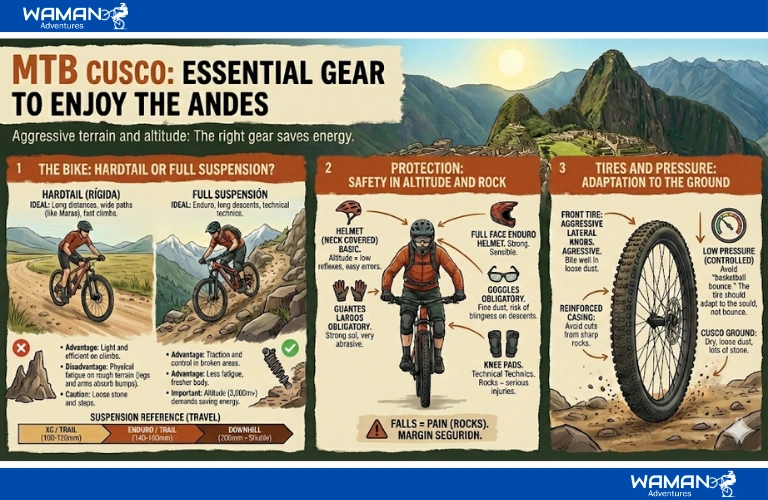
Infographic: MTB Cusco – Essential Gear for the Andes.
Common mistakes when riding MTB in Cusco
Many riders struggle here because they overlook these strategic details.
- Underestimating the physical factor: At 11,152 ft (3,399 m) above sea level, your cardiovascular system does not respond the same way, and fatigue hits fast. That physical fatigue slows decision making and triggers basic handling mistakes.
- Fighting the terrain: On this ground, good technique means modulating speed and braking before the corner, never inside it. Because Andean terrain rebounds, riding tense makes the bike drift off line; you need to stay loose to keep traction.
- Vision and trail reading failures: Staring at your front wheel keeps you from anticipating rocks and drainage channels. You need to look farther ahead to read the trail and avoid late reactions or braking halfway through a technical section in rough terrain.
- Ignoring basic bike setup: Wrong tire pressure destabilizes your descent. Too high and you lose cornering grip; too low and you smash the rim. Check elevation profiles in apps like Trailforks so you can dial in your setup before you ride.

The views of the river and the villages in the distance make these tours special.
Use this as a guide, not a final answer. Start on terrain where you feel confident, dial in your gear, give your body time to acclimatize, and only step up the difficulty when your technique and fitness are ready for the Andes. That is the smartest way to enjoy MTB in Cusco and improve as a rider without forcing the experience.
Thousands of travelers have trusted Peru Biking Tours to live unforgettable experiences in the Andes.
Your safety first
Routes adapted to your level, expert local guides and full support at all times.
Without worrying about anything
We take care of all the logistics so you can just focus on enjoying the scenery.
Authentic routes in Cusco
Experience the Sacred Valley in a real way, at your own pace, with access to the best trails.
Quality equipment
High-end enduro bikes, helmets and protective gear for all levels.
Plan your MTB experience in Cusco
MTB Day Tours in Cusco
If you want to explore MTB routes with the right logistics, local support, and suitable trail selection, check out our MTB Day Tours in Cusco.
E-bikes Tours
Curious how altitude impacts your e-bike in Cusco? Our E-Bike tours are designed for riders who want authentic enduro adventures in the Andes.


